
Your shopping cart is empty!
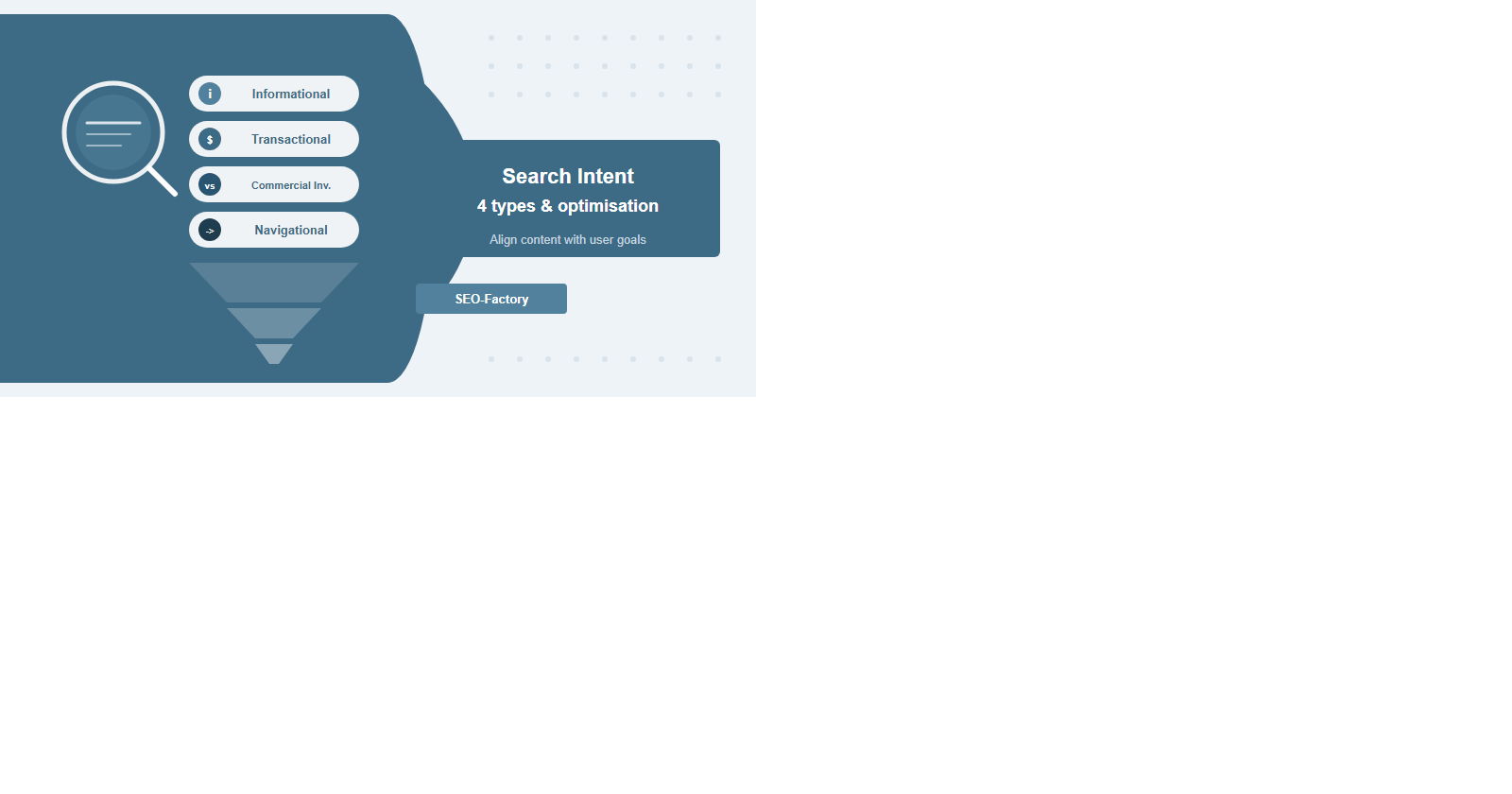
Search intent is the underlying goal behind every query Google receives. Get the intent wrong and no amount of technical SEO or link building will earn you a top-10 position — the algorithm is simply optimised to serve the right page type, not the best-written one.
What search intent is and why Google prioritises it
Search intent — sometimes called user intent — is the primary goal driving a person's query. Are they trying to learn something, buy something, compare options, or navigate to a specific website? Google has spent years training its algorithm to distinguish between these scenarios and to surface the page type that best matches each one.
The practical consequence is straightforward: Google evaluates three dimensions of every ranking page. First, content type — is this a blog post, a landing page, a product listing, a video? Second, content format — step-by-step guide, numbered list, comparison table, definition-plus-example? Third, content angle — written for beginners or experts, broad overview or deep-dive, current year or evergreen? When all three dimensions align with what is already ranking, a new page has a genuine shot at top positions.
At SEO-Factory, we tested this alignment principle across more than 40 client projects in 2026. Pages where we deliberately matched all three dimensions to the dominant SERP pattern saw average position improvements of 14-22 positions within 60 days — without any additional link building. The content had not changed in quality, only in its alignment with intent.
Google's own guidance makes this explicit. Their helpful content guidelines state that pages should be created for people first — meaning they should satisfy the actual need behind the query, not just include the keyword.
4 types of search intent with examples
The standard framework divides all queries into four intent categories. Each demands a different page type, a different content format, and a different depth. Confusing them is one of the most common — and most costly — SEO mistakes.
1. Informational — "I want to learn"
The largest group of queries across almost every niche. The user wants an answer, explanation, definition, or how-to guide. Classic markers include "what is", "how to", "why", "when", "guide to". But markers are not always present — a query like "SEO for e-commerce" is informational, because the user wants to understand the topic rather than immediately hire an agency.
2. Transactional — "I want to act"
The user has made a decision and is ready to buy, sign up, download, or subscribe. Markers include "buy", "order", "price", "cost", "download", "free trial". These queries need pages with a prominent CTA, a form or cart, and clear pricing. A blog post will not compete here, regardless of how well it is written.
3. Commercial Investigation — "I want to compare before I decide"
The user is close to a decision but still evaluating options. Markers include "best", "top", "vs", "comparison", "review", "alternative", "ranking". The winning format is a structured comparison — a "top-X" list or a review with a comparison table. A pure sales landing page will under-perform because the user is not yet ready to commit.
4. Navigational — "I want to reach a specific site"
The user already knows where they want to go and uses search as a shortcut. Markers include brand names, "login", "dashboard", "official site". For a third-party website, competing for another brand's navigational query is essentially impossible. The focus here should be on owning your own brand queries and preventing competitors from capturing them.
| Intent type | Query markers | Best page type | Conversion potential |
|---|---|---|---|
| Informational | what, how, why, when | Article, guide, FAQ | Low (top of funnel) |
| Transactional | buy, order, price, cost | Landing page, product card | Very high |
| Commercial Investigation | best, vs, review, top | Comparison, top-X list | Medium |
| Navigational | brand name, login | Homepage / brand page | Depends on brand |
How to identify intent from the top-10 SERP
The most reliable method for determining the intent of a query is to look at what Google already ranks in positions 1-10. The algorithm has processed billions of user signals for each query and selected the page types that best satisfy the majority of searchers. The existing top 10 is, in effect, a Google-verified template for that query's intent.
Open the top 7-10 results in an incognito window — this removes personalisation — and answer three questions. What type of pages dominate: articles, landing pages, product listings, or videos? What is the predominant content format: step-by-step instructions, ranked lists, comparison tables, or definition-style answers? What angle do the ranking pages take: written for beginners or advanced users, a general overview or a narrow specialist deep-dive?
Working rule: if at least 6 out of 10 results share the same page type, that is a strong signal of the dominant intent. Do not attempt to rank a different content type for that query — Google has validated this pattern with billions of real clicks.
Beyond page types, read the SERP features themselves. A "People Also Ask" box signals informational or research intent. A Google Shopping carousel means transactional. A local map pack means local plus transactional. A featured snippet with a short definition indicates informational intent with a clear featured-snippet opportunity.
Informational intent: formats and structure
Informational queries make up the majority of searches in virtually every industry. Many businesses under-invest in this content type, focusing only on conversion pages. The result is a gap in the funnel — potential customers never encounter the brand during the research phase and arrive at competitors' transactional pages already warmed up.
Google expects specific formats depending on the informational sub-type. For "what is" queries: a clear definition in the opening paragraph, followed by explanation and examples. For "how to" queries: a numbered list of steps, ideally with HowTo structured data to compete for featured snippets. For "why" queries: causal reasoning with concrete supporting evidence. For "tips on X" queries: a structured list with actionable recommendations, not abstract advice.
- Answer depth: cover the related sub-questions users ask after the primary query — the People Also Ask box shows these directly in the SERP.
- Scannability: H2/H3 headers, bullet lists, and tables let a reader locate the answer in under 10 seconds of scanning. This is what Google's quality raters look for.
- Internal promotion: from informational articles, guide readers naturally toward commercial pages with relevant contextual CTAs — not a banner, a sentence.
- Featured snippet targeting: for definition queries, place a 40-60 word answer immediately after the relevant H2. This is the format Google extracts for position zero.
"In our experience optimising content for 30+ projects, pages with a clear HowTo schema and a direct answer in the first paragraph after H2 earned featured snippets at 2.3x the rate of pages without this structure." — SEO-Factory internal analysis.
Transactional intent: conversion pages
Transactional intent is the most commercially valuable category because the user has already made their decision. The page's job is not to persuade — that happened earlier in the funnel — but to remove every possible friction from completing the action. Each extra second of load time, each unnecessary form field, each unclear CTA reduces conversion rate.
A well-structured transactional page includes: a clear H1 containing the keyword and a concrete benefit, a visible CTA button or form above the fold, transparent pricing (users abandon pages with no price information at much higher rates), social proof (reviews, client logos, volume numbers), and risk-reduction signals (money-back guarantee, free audit, trial period).
The critical mismatch: publishing a blog article on a URL where Google expects a landing page. If the top 10 for "SEO agency London" are all service pages, your informational article will not rank there — no matter how thorough it is. The same applies in reverse: a sales landing page optimised for "what is anchor text" will not compete with educational articles. For more on page structure, see our guide to optimising meta tags and heading structure.
Commercial investigation: comparisons and reviews
Commercial investigation sits in the transition zone between informational and transactional intent. The user is close to a decision but not yet there — they are reading reviews, comparing features, and weighing options. Markers include "best", "top 5", "vs", "comparison", "alternatives", "review", "worth it".
The most effective format is a structured comparison: "X best [products/services] for [specific use case]", with a comparison table covering key criteria, an honest assessment of each option's strengths and weaknesses, and a clear recommendation framed as "best for [type of user]". Google ranks these pages for commercial investigation queries because they best satisfy the decision-making need.
- Comparison table: non-negotiable. Without it, the page is just a list of paragraphs — a competitor's table will win the SERP slot.
- Objectivity: even if you are promoting your own service, acknowledge real limitations. Readers detect promotional bias instantly, and it destroys trust.
- Freshness signals: include "Updated 2026" in the title or intro. For comparison content, recency is a significant ranking factor.
- Bridge to transaction: end each option summary with a link to the relevant service or product page — this is where the commercial investigation page earns its conversion value.
Navigational intent: the special case
Navigational queries are a unique case. The user already knows the destination and uses Google as a shortcut. "Ahrefs login", "Google Analytics dashboard", "HubSpot CRM" — these are all navigational. For a third-party website, there is no realistic path to outranking a brand on its own navigational query. The algorithm has essentially hard-wired those results.
What navigational intent does matter for is brand ownership. If a search for your own brand name surfaces a competitor's comparison page, a negative review site, or an aggregator directory in position one before your homepage — that is a genuine problem requiring structured data, brand mentions, and reputation management. We have worked through this scenario with several clients in competitive B2B niches.
The adjacent opportunity is in competitor-adjacent navigational queries. When someone searches "[competitor name] alternatives", the intent shifts from pure navigational to commercial investigation. A well-structured "[your product] vs [competitor]" comparison page can capture this traffic. This is one of the most effective entry points for a challenger brand entering a market dominated by established players.
Micro-intents and mixed queries
Reality is messier than four clean categories. Many queries carry elements of two intent types simultaneously — these are called mixed-intent or multi-intent queries. "CRM software for small business" blends informational ("what options exist") with commercial investigation ("which one should I choose"). "Best SEO agency near me" blends commercial investigation with local transactional intent.
When Google encounters a mixed-intent query, the SERP typically reflects it: you may see both comparison articles and service landing pages in the top 10. The right response is not to pick one intent and ignore the other, but to build a page that satisfies both. For the CRM example, this means an overview of the solution type, a comparison table of leading platforms, and a natural CTA to get started — all on a single, well-structured page.
Micro-intents also appear within informational queries. Someone searching "how to do a technical SEO audit" may actually want a downloadable checklist (a do-it-yourself micro-intent) or a prompt to hire an agency (an outsource micro-intent). The top-10 SERP will reveal which micro-intent dominates. For our own resources on this, see the step-by-step technical SEO audit guide.
Intent mismatch errors and how to fix them
Intent mismatch is one of the most common causes of high-quality content failing to rank. At SEO-Factory, we encounter it in roughly half of all SEO audits we run. Here are the patterns we see most often:
- Article targeting a transactional query: "Buy used laptop London" — Google ranks product listings. A guide to buying laptops will not compete, regardless of its quality.
- Landing page targeting an informational query: "What is a canonical tag" — Google expects educational content. A services landing page will be outranked by articles explaining the concept.
- Correct type, wrong format: the page is a blog article, which is right — but it is a wall of text without H2/H3 structure, lists, or tables. A competitor's structured article will beat it.
- Mixed intent, single response: for a query with dual informational and commercial investigation intent, the page addresses only one — and loses the other half of the audience.
- Intent cannibalization: two pages on the same site target the same keyword with different content types. Google cannot determine which to rank and deprioritises both.
How to find these issues fast: in Google Search Console, filter for queries with high impression count but CTR below 2% and average position above 10. For each such query, check the SERP intent — then check whether your ranking page matches it. Mismatches are your clearest optimisation opportunities.
Tools for analysing search intent
Most major SEO platforms now surface intent classification directly in their keyword research interfaces. This makes it practical to segment a large keyword list by intent type before building any content plan.
- Ahrefs Keywords Explorer: the "Intent" column classifies each keyword across the four types. Use it to filter and group a large semantic list by intent before deciding on page types.
- Semrush Keyword Magic Tool: intent filter lets you segment results instantly. Useful for building intent-segmented content calendars from a single seed keyword.
- Surfer SEO: analyses the top-10 SERP and gives structural recommendations based on what is already ranking. Helps align format and depth, not just intent type.
- Google People Also Ask: free and direct. Shows the micro-questions users ask around a primary query, revealing the informational sub-intents you need to cover.
- Google Search Console: shows the actual queries bringing users to each page. Cross-referencing landing page type with query intent reveals structural mismatches across your entire site.
| Tool | Intent identification | SERP analysis | Cost |
|---|---|---|---|
| Ahrefs | Automatic classification | Yes | Paid |
| Semrush | Intent filter | Yes | Paid |
| Surfer SEO | Top-10 analysis | Yes | Paid |
| Google SERP | Manual analysis | Yes | Free |
| Search Console | Real query data | Partial | Free |
One important caveat: no tool classifies intent with the same accuracy as a trained human reviewing the SERP directly. The tools use pattern-matching heuristics; they miss nuance in mixed-intent queries and can mis-classify navigational brand queries as transactional. For your highest-priority target keywords, always validate tool output by opening the SERP yourself. Pair this with the semantic structuring process described in our guide to building and clustering a keyword semantic core.
Frequently Asked Questions
What is search intent and why does it matter for SEO?
Search intent is the primary goal a user has when entering a query into Google. The algorithm identifies this goal and ranks pages that best satisfy it. If your page does not match the intent — regardless of its technical quality or backlink strength — it will not reach the top results.
How do you identify the search intent of a query?
Analyse the top-10 results in incognito mode. Look at the page type (article, landing page, product listing), the content format (guide, numbered list, comparison table), and the content angle (beginner vs. advanced, broad vs. specific). If at least 6 out of 10 results share the same page type, that signals the dominant intent for that query.
Can a single query have multiple intents?
Yes — these are called mixed-intent queries. For example, "CRM for small business" blends informational and commercial investigation intent. The ideal page satisfies both: an overview of the solution type, a comparison table, and a clear call to action. The SERP for such queries typically includes both article-style and landing page-style results.
How often does Google change its interpretation of intent?
Regularly. After every major algorithm update, the SERP for some queries shifts considerably. Check the top-10 for your target queries at least once per quarter, and immediately after any significant Google update — particularly broad core and helpful content updates.
Does intent alignment affect E-E-A-T?
Directly — yes. Google evaluates how useful a page is for the specific intent behind the query. Choosing the right content format, providing appropriate depth, and matching the page type to user need are all E-E-A-T signals that build trust with both Google and the reader.
Need a content strategy aligned with search intent?
SEO-Factory audits your existing content, identifies intent mismatches, and builds a structured optimisation plan to grow organic traffic where it counts.
Get SEO promotion