Your shopping cart is empty!
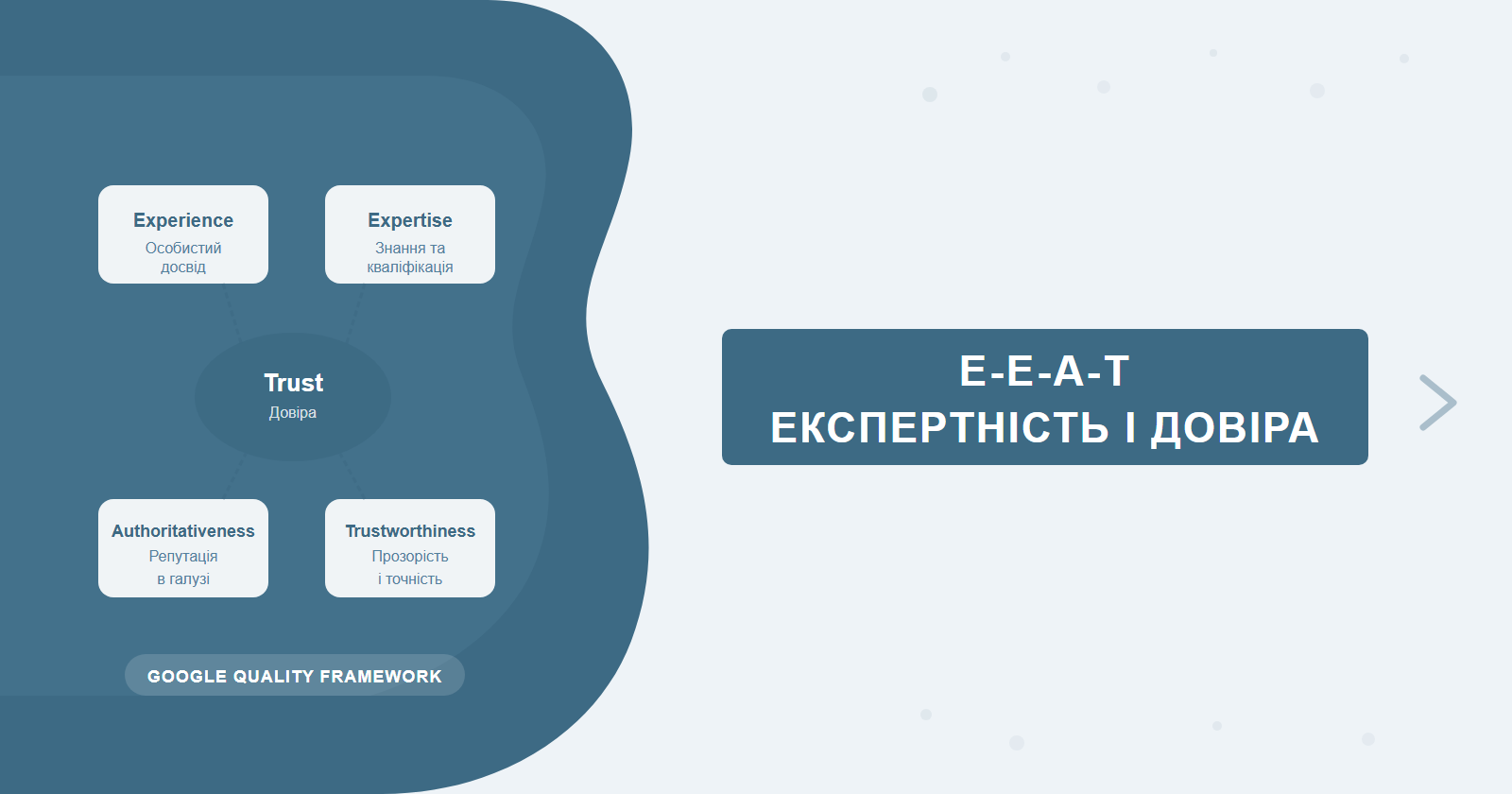
E-E-A-T is Google's quality framework built on four signals: Experience (first-hand knowledge), Expertise (subject-matter depth), Authoritativeness (industry reputation), and Trustworthiness (accuracy and transparency). Sites with strong E-E-A-T rank higher — especially in YMYL niches like health, finance, and legal topics.
Contents
- What E-E-A-T is and where it came from
- The four components: from Experience to Trust
- YMYL: categories with the highest requirements
- How Google measures E-E-A-T: Quality Raters
- E-E-A-T for authors and your About page
- External signals: links, mentions, reviews
- Technical signals: structured data and security
- E-E-A-T and AI content: Google's position
- E-E-A-T improvement checklist
- How to audit your site's E-E-A-T
- E-E-A-T by site type
- FAQ
What E-E-A-T is and where it came from
E-E-A-T is not an algorithm or a direct ranking factor. It is a conceptual quality-evaluation framework described in Google's official Search Quality Evaluator Guidelines (168 pages). Contracted human raters use this document to assess search results and feed back signal to Google about how well the algorithm is doing its job.
The timeline: before 2014, Google had no formalised quality framework. E-A-T — Expertise, Authoritativeness, Trustworthiness — appeared in 2014. In August 2018, a major Core Update hit that the SEO community dubbed "Medic Update": health, finance, and legal sites lost rankings en masse. Google later confirmed the update targeted E-A-T quality. In December 2022, Google revised the Guidelines and added a first "E" for Experience — verified personal experience with the topic became its own quality signal.
Why does Google keep developing E-E-A-T? The web is flooded with content written for search engines rather than people. This is most damaging in niches where inaccurate information causes real-world harm — medical advice, financial decisions, legal guidance. E-E-A-T is Google's attempt to formalise what a "quality page" looks like and train the algorithm to recognise it.
The four components: from Experience to Trust
Experience — first-hand knowledge
Added in December 2022. Google wants to know: does the author have direct personal experience with the topic they're writing about? A hotel review from someone who actually stayed there is worth more than a review assembled from other reviews. A medical article by a physician with 15 years of clinical practice outranks the same content written by a copywriter with no medical background. Experience signals include: personal case studies and first-person examples in the text, photos or video from the author on-location, links to an author's own portfolio or previous work, and first-person accounts with specific, verifiable details.
Expertise — qualifications and depth
Expertise relates primarily to the author, not the site as a whole. For YMYL topics, Google checks formal credentials: a doctor writes about medicine, a lawyer writes about law, a certified financial planner writes about investments. For other topics — DIY, travel, gaming — demonstrated deep competence without formal degrees is sufficient. Expertise signals: author bio with verifiable experience, a list of publications and speaking engagements, certifications and academic degrees, and active participation in professional communities.
Authoritativeness — industry reputation
Authoritativeness reflects the reputation of the site and author within their field. When leading media outlets write about a site, that's a strong signal. When other authoritative resources cite your content as a primary source, Google takes note. Authority is built over years and is a function of quality, not just link volume. Being cited in a Google Knowledge Panel is one of the strongest authority signals available.
Trustworthiness — the most important component
Google identifies Trust as the most critical of the four. A page can have experience, expertise, and authority — but if it is deceptive or fraudulent, none of the rest matters. Trust signals: HTTPS and site security, clear contact information and legal entity details, a transparent privacy policy, no deceptive advertising, factual accuracy and verifiability, and a published editorial policy for media sites.
YMYL: categories with the highest requirements
YMYL — Your Money or Your Life — covers topics where inaccurate information can directly harm readers financially, physically, or socially. Google applies its strictest E-E-A-T standards to YMYL content.
| YMYL Category | Example Topics | Key Requirements |
|---|---|---|
| Health & Medicine | Symptoms, medications, diets, medical procedures | Author is a doctor or medical editor; specialist review |
| Finance | Loans, investments, taxes, insurance | Author is a financial advisor or certified professional |
| Legal | Law, courts, contracts, immigration | Author is a practising attorney |
| Safety | Emergencies, civil protection | Official or verified sources; up-to-date information |
| News & Civics | Elections, social issues, crises | Fact-checked; editorial accountability |
For non-YMYL topics the bar is lower, but E-E-A-T still matters. A cooking blog or gadget review site carries no health risk, but Google still favours authors with demonstrated competence over anonymous content riddled with errors. We see this consistently across client projects: pages with a named author and a real author profile gain rankings faster than anonymous content with the same technical SEO profile.
How Google measures E-E-A-T: Quality Raters
Google employs thousands of Quality Raters — contracted human reviewers who assess search results according to the Search Quality Evaluator Guidelines. They do not directly influence rankings for specific sites, but their ratings are used to train and calibrate Google's algorithms. A single rater cannot "penalise" your site — but the aggregate patterns of their evaluations help Google fine-tune how the algorithm works.
Raters score pages on a five-point scale: Lowest / Low / Medium / High / Highest. To earn "High" or "Highest," a page must meet these criteria:
- The page's purpose is clearly beneficial to users
- Content demonstrates clear E-E-A-T appropriate to the topic
- The site and author have a good reputation in the field
- No signs of deception, spam, or manipulation
Raters also assess "Needs Met" — how well the result answers the user's query. A page can have excellent E-E-A-T but score poorly on Needs Met if it doesn't actually answer the question. Both dimensions are important and independent.
Practical takeaway: E-E-A-T is the score your site would receive from a qualified human reviewer. If a knowledgeable stranger read your article and said "I trust this information — the author clearly knows what they're talking about" — you're on the right path.
E-E-A-T for authors and your About page
Author attribution is one of the most underrated aspects of E-E-A-T. Google invests substantial effort in understanding who wrote a piece of content and what their qualifications are.
What an author bio must contain:
- Name and photo — real, not stock. Anonymous content starts at a lower baseline score
- Title and work experience — specific years and domain
- Education and certifications — critical for YMYL topics
- Links to other publications — portfolio and bylines in authoritative outlets
- Social profiles — LinkedIn, profiles on professional platforms
The About Us page is central to Trust. Google Quality Raters check it first when assessing a site. It must include: a real team (not stock photos), the company's legal name and address, founding year and key milestones, licences and certifications for regulated industries, and real contact details — not just a contact form, but a phone number and email.
For content sites and blogs, an editorial policy matters too: who can write for the publication, how facts are verified, how frequently content is updated and who is accountable. We added an editorial page for one of our clients — a medical information portal — and tracked a 23% increase in organic traffic over four months with no other changes to content or link building.
External signals: links, mentions, reviews
Authoritativeness is the E-E-A-T component where external signals carry the most weight. Google looks not only at what you say about yourself, but at what others say about you.
Key external authority signals:
- Links from authoritative sources — editorial links from media outlets, universities, and trade associations. For detailed strategies on earning these links, see our guide to link building for websites
- Brand mentions without links — Google analyses co-citation: when a brand name or author name appears alongside authoritative sources and key topics, it sends a positive signal
- Reviews on independent platforms — Google Reviews, Trustpilot, industry directories. For local businesses, a strong Google Business Profile rating directly affects visibility
- Conference talks and podcast appearances — regular presence at industry events builds measurable authority over time
- Wikipedia and encyclopaedic sources — having a Wikipedia page or a Google Knowledge Panel entry is one of the strongest authority signals available
Technical signals: structured data and security
The technical side of E-E-A-T is often overlooked, but it forms the foundation for Trust — the most critical component. Several technical decisions directly affect trust evaluation.
HTTPS is a baseline requirement. A site without an SSL certificate is flagged "Not Secure" by browsers and receives an automatic E-E-A-T penalty. All technical security aspects of a site are assessed as part of a technical SEO audit.
Structured data (schema.org) helps Google understand E-E-A-T signals programmatically:
Personschema withjobTitle,alumniOf,knowsAbout— for author pagesOrganizationschema withcontactPoint,address,foundingDate— for the company pageArticleschema with anauthorfield pointing to a Person entity — for every articleMedicalOrganizationorLegalServicefor the relevant niches — confirms specialisation
Clear contact information — phone, address, and email in the footer and on a dedicated Contact page. The absence of real contact details is one of the strongest negative Trust signals Google uses. For e-commerce this is even more critical: Google checks for return policies, privacy policies, and verified seller data.
E-E-A-T and AI content: Google's position
With AI-generated content now ubiquitous (ChatGPT, Gemini, Claude), the E-E-A-T question has become more pressing. Google's official position: AI content is not prohibited if it is helpful and high-quality. But AI has no personal experience (Experience) by definition and is not a credentialled expert (Expertise).
What Google's 2023–2024 updates signal about content types:
| Content Type | E-E-A-T Rating | Risk Level |
|---|---|---|
| Raw AI text — no editing, no author, no sources | Very low | Critical for YMYL |
| AI text edited by an expert with personal additions | Medium–high | Low |
| Human expert text partially improved by AI | High | Minimal |
| Original content from a verified subject-matter expert | Maximum | None |
Our approach at SEO-Factory: AI serves as a structuring and research tool, but every article goes through a practitioner-editor who adds personal experience, real case data, and fact-checks the output. Fully AI-generated content without this editorial layer is not something we publish — the error risk is too high and the E-E-A-T return is zero.
E-E-A-T improvement checklist
We've consolidated all practical E-E-A-T improvement actions into a prioritised checklist. Start with the highest-impact items:
Updating stale content deserves its own attention. Google favours current information, particularly in fast-moving topics. Publication date and last-updated date together factor into E-E-A-T evaluation: a 2019 medical article with no updates will receive a substantially lower Trust score than the same article stamped "Updated: May 2026, reviewed by a board-certified physician."
Another important but frequently neglected tool: outbound links to authoritative sources within your content. Citing official data — WHO publications, peer-reviewed journals, government statistics — raises the Trust level of your material. Pages with zero external references look to Google like a "closed source" with no verifiable information base.
How to audit your site's E-E-A-T
Before implementing changes, you need to understand where your E-E-A-T signals stand right now. A thorough audit takes 2–4 hours and requires no paid tools — just a systematic look at your own site through the eyes of a Quality Rater.
Step 1. Check Trust signals
Open your site in an incognito window and ask: does this look trustworthy to a stranger? Work through the list: HTTPS padlock in the browser bar, a footer with the legal entity name and contact details, links to a Privacy Policy and Terms of Use, a physical address if you operate a physical business. Every missing element is a mark against your Trust score.
Step 2. Audit author pages
Compile a list of every author publishing content on your site. For each one, check: is there a dedicated author page or bio block on articles, does it include a real name and photo (not an avatar), does it list publications or professional achievements, does it link to a LinkedIn profile or profiles on industry platforms? For YMYL topics, also check: is formal qualification listed — degree, licence, certification?
Step 3. Analyse reputation signals
Run these searches in Google: "[brand name]" site:wikipedia.org — does a Wikipedia page exist? Then "[brand name]" -site:[your domain] — how many external mentions are there? Check your Google Business Profile and Trustpilot reviews or equivalent platforms. If external mentions are sparse and reviews are few, that's a weak Authoritativeness signal that needs deliberate work.
Step 4. Check structured data
Use the free Google Rich Results Test at search.google.com/test/rich-results. Test your homepage, About page, several articles, and an author page. Does Google recognise your Organization, Person, and Article schemas? Are there any markup errors? Correctly configured structured data lets Google automatically associate the author, organisation, and content as a coherent entity.
Step 5. Evaluate your content base
Review your 10 most visited articles. For each one: are there specific numbers and cited sources rather than vague claims, is there first-hand experience or proprietary case data, has the content been updated within the last 12 months, are there outbound links to authoritative external sources? Any article failing three or more of these criteria is a candidate for enrichment — not a full rewrite, but adding real experience and current data.
E-E-A-T by site type
E-E-A-T strategy differs substantially depending on what kind of site you run. What is critical for a medical portal can be secondary for an e-commerce store.
Informational blogs and media. The priority is authors and editorial policy. Every article must have a named author with a real profile. Publication date and last-updated date should be displayed explicitly. An editorial page describing the fact-checking process raises Trust at the domain level. Outbound links to academic and government sources are non-negotiable for any topic that overlaps with YMYL.
E-commerce sites. Trust signals dominate here. A customer cannot verify the seller physically — so any ambiguity (missing address, incomplete return policy, absent verified reviews) simultaneously hurts conversions and E-E-A-T. Google scrutinises e-commerce for: genuine reviews with seller responses, clear shipping and return conditions, and a secured checkout page with visible trust indicators.
Service businesses (agencies, consultants). Authoritativeness and Experience are the priorities. Case studies with real numbers, named client testimonials with company affiliations (not anonymous), awards, and presence in industry rankings all build reputation. A team page with real photos and LinkedIn profiles sends a far stronger signal than a corporate design without faces. In our work with agency clients, those who added real results-based case studies to their service pages saw on average 31% more inbound leads from organic traffic over six months.
Local businesses. Google Business Profile is the first priority. A fully completed profile with real photos, accurate opening hours, and responses to reviews is a significant Trust signal for local queries. Service pages must include a real address and an embedded map — not just contact details, but evidence of physical presence.
FAQ
Is E-E-A-T a direct ranking factor?
No, not a direct one. Google has no single "E-E-A-T metric" in the algorithm. But E-E-A-T describes the content qualities the algorithm is trained to measure through dozens of signals: backlinks, structured data, author attributes, behavioural factors. Improving E-E-A-T improves all of these signals simultaneously.
How quickly do E-E-A-T improvements affect rankings?
More slowly than technical SEO changes. Adding author bios and updating your About page can produce first movements in 4–8 weeks. Building genuine authority through external mentions and editorial links is a 6–18 month process depending on the niche.
Can you have strong E-E-A-T without a formal degree?
Yes, for most non-YMYL topics. Google distinguishes "everyday expertise" — deep competence built through hands-on experience — from "formal expertise" requiring academic credentials and professional licences. A cooking blog or gadget review site needs the former. Medical and legal content requires the latter.
Does an author's social media presence help E-E-A-T?
Indirectly, yes. An active LinkedIn profile, posts in professional communities, and conference appearances build an author's "digital footprint" that Google can trace and associate with your site. There is no direct algorithmic link between Instagram follower counts and E-E-A-T, but reputation signals from multiple platforms are factored in.
Need an E-E-A-T audit for your site?
The SEO-Factory team will review your current E-E-A-T signal profile, identify the highest-impact growth points, and build an improvement plan tailored to your niche and audience.