Your shopping cart is empty!
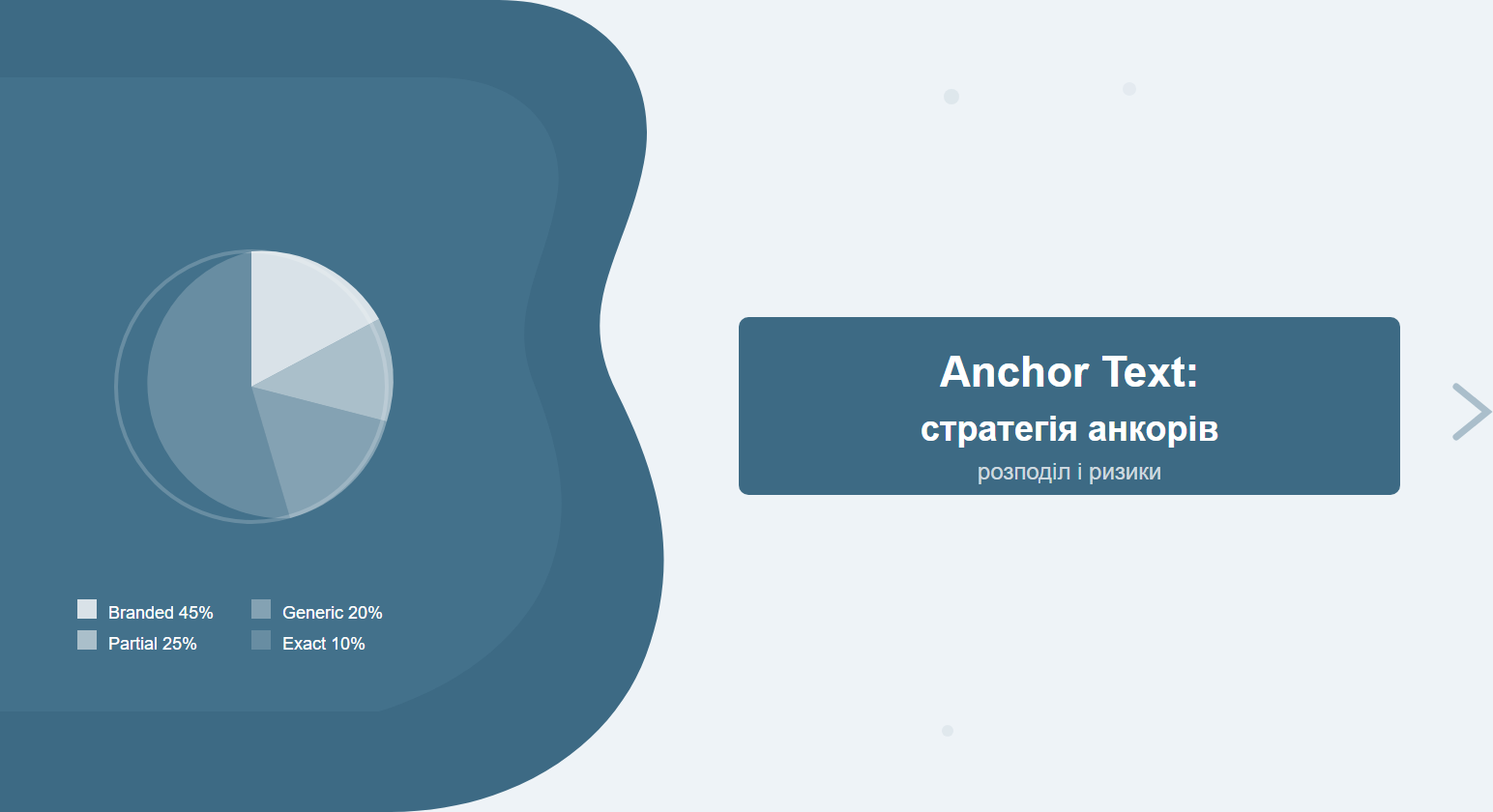
Anchor text is the visible, clickable text of a hyperlink. For Google it works as a relevance signal: if dozens of sites link to your page with the anchor "SEO audit," the search engine infers that your page is genuinely about SEO audits. The flip side is that over-optimizing your anchor profile is one of the primary signals targeted by Penguin and SpamBrain.
Table of Contents
- Anchor text types: from exact match to image
- Optimal anchor distribution
- Over-optimization risks and Penguin
- Internal links: a different set of rules
- How to analyse your anchor profile
- Common mistakes and how to avoid them
- Anchor profile audit checklist
- Frequently asked questions
Anchor text types: from exact match to image
Not all anchors are equal — either for Google or for risk level. Let's break down each type and where it belongs.
Exact match
The anchor text exactly matches the target keyword: "buy laptop," "order SEO services." This is the strongest relevance signal, but simultaneously the riskiest. A natural link profile rarely contains many exact match anchors — real authors typically write "here," "learn more," or the brand name.
Partial match
The keyword is present but in a broader context: "best laptops for working from home," "SEO promotion services for small businesses." Looks organic, conveys a topical signal without obvious manipulation.
Branded
The company or site name: "Apple," "SEO-Factory," "seo-factory.com.ua." The safest anchor type — this is exactly what an external author would naturally write. Branded anchors should dominate a healthy profile.
Generic
"Here," "click," "read more," "this website," "source." Carry no topical signal but are a hallmark of a natural profile: this is how real authors link without SEO motivation.
Naked URL
The link itself as visible text: "https://seo-factory.com.ua" or "seo-factory.com.ua." Common on forums, social media, news aggregators. Neutral for Google, useful for diversity.
Image anchor
When a link wraps an image rather than text, Google reads the alt attribute as the anchor. If alt is empty — the link is treated as generic. Fill alt attributes descriptively, but avoid keyword stuffing.
Optimal anchor distribution
There is no perfect formula — distribution depends on niche, competitors, and your current profile state. But there are benchmarks that reflect a natural link mass:
| Anchor Type | Recommended Share | Signal for Google | Risk |
|---|---|---|---|
| Branded | 40–50% | Brand recognition | Minimal |
| Generic / Naked URL | 20–25% | Natural profile | None |
| Partial match | 20–25% | Topical relevance | Low |
| Exact match | 5–10% | Direct keyword signal | High when exceeded |
Compare your profile to the top 3 competitors in the same niche. If leaders carry 12% exact match and rank stably, your niche is probably more tolerant. But in competitive verticals — finance, legal, e-commerce — even 8% can be excessive.
Practical rule: anchor distribution is not a fixed formula but a snapshot of natural activity. If your site is well known, branded anchors will organically dominate. If not, deliberately build branded and generic links to restore balance.
Over-optimization risks and Penguin
Google Penguin (launched 2012, baked into the core algorithm since 2016) and its modern counterpart SpamBrain analyse anchor profiles in real time. They don't just check the exact match percentage — the algorithm looks at patterns as a whole.
What triggers the algorithm
- Identical anchor on all or most backlinks. A genuine author never uses the exact same anchor text across hundreds of different pages.
- A sudden spike in exact match anchors. Ten new backlinks in a single month all carrying the same keyword — suspicious of PBN or bulk buying.
- Mismatch between anchor and donor page content. A cooking blog linking to an SEO service with "website promotion" as anchor is a blatant spam signal.
- Keyword stuffing in anchor text. "Buy cheap SEO promotion services Kyiv 2024" — that's manipulation, not an anchor.
"Links intended to manipulate rankings in Google Search may be considered link spam."
— Google Search Essentials: Link spam policies
If a site has already been hit by a filter, recovery takes time: first disavow the problematic links via Google Search Console, then grow a quality natural link mass. An abrupt disavow without compensatory link building can temporarily drop rankings — act gradually.
Internal links: a different set of rules
Internal anchors are a completely different game. Google is far more lenient about anchor text within a site because it understands that the owner controls the architecture — there's no external vote manipulation here.
This means you can and should use descriptive keyword-rich anchors in internal links. They help the search engine understand the topic of the target page. Instead of "read more," write "how to build a backlink profile" or "technical SEO audit step by step."
Key rule for internal anchors: avoid having dozens of pages linking to a single page with the exact same anchor text. Variety is the key to looking natural, even in internal link building.
For a deep dive into internal link architecture, see our guide on internal linking: site architecture and link flow.
How to analyse your anchor profile
An anchor audit is the first step before any link building strategy. Without understanding the current state, you can't know what's missing or where the danger lies.
Ahrefs: Anchors report
In Site Explorer → Backlinks → Anchors you'll see the full picture: a list of all anchors, the number of referring domains and backlinks for each, and their share. Sort by referring domains — this shows which anchors are most widespread. The "Dofollow" filter lets you focus on links that actually influence rankings.
Semrush: Backlinks → Anchors
Equivalent functionality in Backlink Analytics → Anchors. There's also a built-in filter by type: branded / URL / generic / keyword — useful for fast classification without manual sorting.
What to look for during analysis
- Exact match share by referring domains — the primary metric.
- Concentration: does a single anchor dominate? More than 30–40% of all links — a suspicious pattern.
- Anchor text in context of donor pages: does it match, or is it planted out of nowhere?
- Velocity: a sudden surge of a specific anchor within a short period — a sign of spammy activity.
Before building new backlinks, it's also worth verifying the technical health of your site. See our guide on technical SEO audit step by step.
Common mistakes and how to avoid them
Most anchor profile problems stem from too much control, not too little. Trying to "optimise" every single backlink leads to an unnatural pattern that Google's algorithms recognise quickly.
Mistake 1: bulk exact match in guest posts
An SEO orders 50 guest articles and specifies "buy X" as the anchor in every one. The result: 50 identical anchor texts across different sources. Google spots the pattern within weeks. Fix: vary anchors even in controlled link building — branded, partial, and generic anchors should rotate.
Mistake 2: ignoring generic and branded in the strategy
Some specialists dismiss generic anchors as "useless" and focus exclusively on keywords. In reality, the share of "here," "read more," and naked URLs signals organic activity — and that's exactly what's missing in profiles that get filtered.
Mistake 3: the same anchor across different pages of the site
If all backlinks point to the homepage with "SEO-Factory" and none to inner pages, the algorithm can't understand the site structure. Distribute links across different pages with varied anchors.
Mistake 4: ignoring donor context
Even a branded anchor in an irrelevant context looks suspicious. "SEO-Factory" on a cooking blog — minimal value and a potential artificiality signal.
For a full guide on building a healthy backlink profile, see our article on link building and backlink profiles.
Anchor profile audit checklist
Use this table as a starting point for a regular audit — quarterly or before a major link building campaign.
| Check | Tool | Benchmark | Status |
|---|---|---|---|
| Exact match share of all domains | Ahrefs / Semrush | ≤10% | □ |
| Branded anchor share | Ahrefs / Semrush | ≥40% | □ |
| Presence of generic and naked URL anchors | Ahrefs / Semrush | ≥20% combined | □ |
| One anchor dominates (>40% of all links) | Ahrefs Anchors | No | □ |
| Sudden spike in a single anchor this month | Ahrefs History | Absent | □ |
| Anchor matches donor page context | Manual review | Relevant context | □ |
| Anchor profile vs top-3 competitors | Ahrefs Compare | Similar pattern | □ |
| No keyword stuffing in anchor texts | Manual review | Natural phrasing | □ |
Frequently asked questions
Can a site receive a penalty purely because of its anchor profile?
Yes. SpamBrain analyses the link profile as a signal: if 80% of backlinks share the same exact match anchor, it's a clear manipulation flag. The result is usually not an instant manual penalty but a gradual ranking drop that's hard to trace without an audit.
How does Google handle anchor text in images?
Google reads the alt attribute of a linked image as the anchor text. If alt is absent or empty, the link is treated as generic (no topical signal). Fill alt descriptively, but avoid over-stuffing with keywords.
Should I disavow links solely because of a bad anchor?
Not necessarily. If the donor has strong authority and a natural context, even an exact match anchor isn't automatically harmful. Disavow is warranted when a low-quality donor, spammy context, and a problematic anchor all coincide. Always analyse holistically.
FAQ
What percentage of exact match anchors is safe?
For most niches, the guideline is no more than 5–10% of all external anchors. In competitive verticals, even 7% can trigger a SpamBrain signal.
Does anchor text in internal links affect rankings?
Yes, significantly. Google is more lenient toward internal anchors — penalty risk is minimal, so you can use descriptive keyword-rich anchors to pass topical signals between pages.
What should I do if my anchor profile is already over-optimized?
Start with an audit in Ahrefs or Semrush. If exact match exceeds 15–20%, run a disavow program via Google Search Console while simultaneously building branded and generic backlinks.
Does anchor text matter equally for DoFollow and NoFollow links?
NoFollow links officially don't pass PageRank, but Google uses them as hints. Anchor text in nofollow links still appears in Ahrefs and Semrush profiles — so diversity matters for all link types.
Want an anchor profile audit for your website?
SEO-Factory reviews your anchor type distribution, identifies over-optimisation risks, and builds a safe link building strategy.