Your shopping cart is empty!
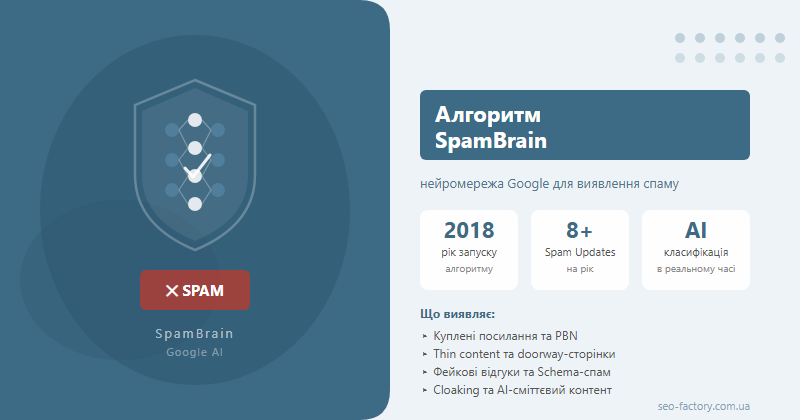
SpamBrain is Google's neural network for spam detection, launched in 2018. It automatically penalizes sites for link manipulation, low-value AI content, and fake structured data — with no warning in Search Console.
Table of Contents
- What SpamBrain Is and Where It Came From
- How It Works: Neural Network vs. Spammers
- What SpamBrain Actually Detects
- Google Spam Updates: Timeline and Scale
- Manual Actions vs. Automatic SpamBrain Filter
- How to Tell If Your Site Got Hit
- Recovery After SpamBrain: Step-by-Step Plan
- How to Protect Your Site Going Forward
What SpamBrain Is and Where It Came From
Before 2018, Google relied heavily on hand-coded rules and manual reviews to fight web spam. Quality Raters flagged pages, engineers wrote filters targeting known manipulation patterns. The fundamental flaw: spammers adapted faster than the rule books could be updated.
SpamBrain changed that dynamic completely. Instead of static rules, it's a deep learning model trained on billions of documents and behavioral signals. The system identifies novel manipulation patterns on its own — even ones nobody has explicitly described yet. Google first publicly confirmed SpamBrain's existence in December 2021, noting that it had already neutralized several large-scale Link Graph attacks.
One detail that often gets overlooked: SpamBrain doesn't just flag spam — it can neutralize the PageRank flow from spammy domains without penalizing the source site itself. A single spammy link from an otherwise okay domain might simply get discounted. But 200 links from a coordinated PBN? That's a detectable pattern, and the receiving site gets filtered.
At SEO-Factory, we've seen SpamBrain's effects firsthand. Clients who purchased links through link exchanges in 2020–2022 saw traffic drops of 30–60% following the 2022 and 2023 Spam Updates. Recovery — after proper link profile cleanup — took between 2 and 6 months.
How It Works: Neural Network vs. Spammers
SpamBrain is a classification model built on deep learning. Google trains it on labeled examples of known spam and clean pages. Once trained, the model generalizes — it catches manipulation schemes it was never explicitly shown, based on learned structural patterns.
What the model analyzes
- Link graph characteristics — clusters of mutually-linking domains; abnormally fast backlink velocity; identical anchor texts appearing across many unrelated sources.
- Content signals — linguistic patterns typical of spun or mass-generated text without original value.
- Behavioral anomalies — hundreds of new doorway pages appearing overnight; bulk domain registrations with identical structure.
- Structured data consistency — mismatches between Schema.org markup and actual page content (e.g., a 4.9-star rating with no visible reviews).
SpamBrain is not a static model. Google retrains it continuously on new data — which means a tactic that "worked" 18 months ago can trigger a penalty today, even if you stopped using it, because the old links are still there.
Key insight: SpamBrain evaluates the entire link graph, not individual links. One spammy backlink from an otherwise strong domain may simply get discounted. But 200 links from structurally similar PBN sites create a detectable pattern that triggers a filter.
What SpamBrain Actually Detects
Google's official Spam Policies documentation lists the main violation categories. SpamBrain automates detection of nearly all of them.
Link spam
| Scheme Type | SpamBrain Signals | Risk Level |
|---|---|---|
| Buying / selling links | Sudden backlink spikes; commercial anchors from irrelevant low-DR domains | Very High |
| Private Blog Networks (PBN) | Domain clusters sharing IPs or hosting; identical page templates; cross-linking patterns | Very High |
| Excessive link exchanges | Two sites heavily cross-linking with commercial anchors and no editorial justification | Medium |
| Mass guest posting | Same "author" on hundreds of domains; identical article structure; matching anchor sets | Medium–High |
| Widget / footer links | Links appearing simultaneously across thousands of pages without editorial selection | Medium |
| Comment spam | High volume of links from forum comments with identical anchor text | Low–Medium |
Content spam
Following the explosion of AI writing tools in 2022–2023, SpamBrain gained a dedicated training track for detecting low-value content. Google's stance is nuanced: AI-generated content with genuine value is permitted; mass-produced doorway pages or scraped content is not.
- Doorway pages — pages optimized for specific queries solely to redirect visitors elsewhere.
- Scraper sites — sites republishing others' content without adding anything original.
- Thin content at scale — thousands of templated pages with negligible unique value.
- Keyword stuffing — unnatural keyword density in body text or meta tags.
- Cloaking — serving different content to Googlebot vs. real users.
Structured data spam
SpamBrain cross-checks Schema.org markup against actual page content. A Product page claiming 4.9/5 from 1,200 reviews when there are no visible reviews on the page is a clear signal. The same applies to local businesses: mismatches between address markup and actual location became a leading cause of Local Pack removals after the 2024 Spam Update.
From SEO-Factory's casework: an e-commerce client lost all Rich Results in 2023 after adding aggregate rating markup without actual on-site reviews. Removing the fabricated markup and publishing real customer reviews restored Rich Results within 6 weeks.
Google Spam Updates: Timeline and Scale
Google Spam Updates are scheduled re-evaluations of the index using an updated version of SpamBrain. Don't conflate them with Core Updates — Spam Updates target manipulative signals specifically, not overall content quality.
| Date | Update / Focus | Duration | Scope |
|---|---|---|---|
| June 2021 | First official Spam Update | ~5 days | Link spam |
| November 2021 | Second Spam Update | ~8 days | Link + content spam |
| October 2022 | Link Spam Update | ~29 days | Large-scale: link buying/selling, PBN |
| December 2022 | Link Spam Update #2 | ~16 days | Guest posts, anchor spam |
| February 2023 | Spam Update | ~4 days | AI-generated thin content |
| October 2023 | Spam Update | ~15 days | Hacked sites, cloaking, site reputation |
| March 2024 | Spam Update (alongside Core) | ~44 days | Scaled content, site reputation abuse, expired domains |
| August 2024 | Spam Update | ~7 days | Structured data spam, fake reviews |
The March 2024 update was the largest in scope to date. For the first time, Google officially called out "site reputation abuse" — where a high-authority site hosts low-quality third-party content — as a distinct violation category. Several major media outlets lost 60–80% of their search traffic from affected sponsored-content sections.
"We've been fighting webspam for 25 years. Today, with SpamBrain, we're neutralizing the vast majority automatically — before it ever reaches users." — Google Search Central Blog, December 2021
Manual Actions vs. Automatic SpamBrain Filter
This distinction is critical — your recovery strategy is entirely different depending on which one you're dealing with.
In practice: if Search Console shows a "Manual Actions" entry, you're dealing with a human-reviewed penalty — work the reconsideration process. If there's nothing in the console but traffic dropped 40–70% in sync with a Spam Update date, that's an automatic filter. Filing a reconsideration request won't help here; clean the profile and wait for the next update cycle.
Worth knowing: a site can face both simultaneously. SpamBrain may automatically filter a site and then escalate the case to a human reviewer, resulting in a manual action on top of the algorithmic filter.
How to Tell If Your Site Got Hit
Diagnosis follows three steps: check Search Console, cross-reference update dates, audit your backlink profile.
Step 1. Search Console — Manual Actions
Go to Search Console → Security & Manual Actions → Manual Actions. If there are entries, read them carefully — they specify exactly what violation was found and which part of the site is affected.
Step 2. Cross-reference Spam Update dates
Check the Google Search Status Dashboard or update history aggregators (Semrush and Moz both maintain current lists). Map your traffic drop against the nearest Spam Update dates. A traffic decline within ±3 days of an update, with no manual action in console, strongly suggests an automatic SpamBrain filter.
Step 3. Backlink audit
Export your full backlink list from Ahrefs or Google Search Console (Links → External links → Download samples). Look for:
- Large volumes of domains with zero traffic and DR below 10
- Commercial anchors ("buy," "order," "price") from off-topic domains
- Links from forum comments, profile pages, auto-submission directories
- Domain clusters with similar naming patterns
- Sharp velocity spikes in new referring domains over a short window
In every technical SEO audit we run, backlink analysis is a non-negotiable section — regardless of what the client's initial complaint is about.
Recovery After SpamBrain: Step-by-Step Plan
Recovering from an automatic filter takes time and follows a clear sequence. Here's what we actually do at SEO-Factory when handling post-SpamBrain recovery engagements.
Stage 1: Full backlink audit (1–2 weeks)
- Pull all backlinks from Ahrefs, Semrush, and Search Console — the datasets differ, you need all three.
- Classify each referring domain: clean / suspicious / clearly toxic.
- Build a consolidated spreadsheet of toxic and suspicious domains.
Stage 2: Link removal outreach (2–4 weeks)
For clearly toxic links, try to find the domain owner's contact and request removal. Conversion rate is typically 10–20% — most spammy sites don't respond. But the outreach attempt matters for documentation before you submit a Disavow file.
Stage 3: Disavow file submission
Prepare the file:
# Date: 2026-06-16. Audit by SEO-Factory.
domain:spam-links-site.ru
domain:pbn-example.net
https://exact-spam-page.com/your-link/
Submit via Search Console → Links → Disavow links. Google doesn't commit to processing timelines, but in our experience the effect is measurable at the next Spam Update.
Stage 4: Content and E-E-A-T
SpamBrain evaluates signals holistically. A clean link profile alone won't restore rankings if the content is thin. Audit your pages against E-E-A-T criteria: Experience, Expertise, Authoritativeness, Trustworthiness.
Recovery timeline expectations
| Situation | Expected Timeline |
|---|---|
| Manual action lifted, profile clean | 2–6 weeks after reconsideration approval |
| Automatic filter, Disavow submitted | 1–4 months (next Spam Update) |
| Severe penalty + weak content | 4–12 months |
| Post-hack spam cleanup | 1–3 months after full remediation |
Important: the Disavow file doesn't remove links from Google's index. Google still sees them — it just stops counting them in PageRank calculations. That's why there's no instant ranking boost; the effect only kicks in when SpamBrain re-evaluates your profile during the next Spam Update.
How to Protect Your Site Going Forward
Protecting your site from SpamBrain comes down to building a link profile and content strategy that would survive any algorithm scrutiny — not just gaming the current model.
Safe link building principles
We cover this in depth in our guide to link building and backlink profile development. The key rules:
- Natural velocity — for a mid-size site without a large existing base, aim for no more than 20–30 new referring domains per month.
- Anchor diversity — 60–70% of anchors should be branded, URL-form, or navigational; commercial keyword anchors should stay below 15–20%.
- Donor quality — target DR≥20, real traffic above 500/month, topically relevant domains.
- Avoid link marketplaces — platforms like Gogetlinks, Miralinks, and similar exchanges have well-known signature patterns that SpamBrain recognizes.
Ongoing monitoring
Even if you're building links ethically, competitors or automated spam bots can build toxic links to your site. Negative SEO is real. Minimum recommended setup:
- Monthly new-backlink alerts in Ahrefs or Semrush.
- Search Console alerts configured for new manual actions.
- Quarterly backlink audit with Disavow file refresh.
Crowd marketing as a safe link-building channel
One of the consistently safe approaches to earning natural mentions is crowd marketing — brand mentions in relevant forum threads, Q&A communities, and niche groups with genuine context. Unlike bulk forum spam, quality crowd marketing generates real referral traffic and contributes to a natural-looking link profile that SpamBrain won't flag.
Questions & Answers
Can SpamBrain falsely penalize a clean site?
In theory, yes — any automated system produces false positives. Google mitigates this through confidence thresholds: isolated signals don't trigger filters. If you're confident your profile is clean but traffic dropped, check Search Console for manual actions and submit a reconsideration request with a clear explanation of your link-building history.
Does SpamBrain affect new sites with no backlinks?
SpamBrain's primary targets are link profiles and content patterns. A brand-new site with zero backlinks won't receive a link penalty — but it can still get caught by content filters if it's filled with thin, templated, or doorway pages from day one.
What does a backlink audit and SpamBrain recovery actually cost?
Cost scales with profile size. For a site with 5,000–20,000 backlinks, a full audit and remediation plan typically takes 2–4 weeks. At SEO-Factory, this work is part of our technical audit package — reach out for a project-specific estimate.
Is the Disavow Tool still worth using?
Yes. Google hasn't deprecated it, and it remains one of the few direct tools you have to communicate link quality signals. It's not instantaneous — effects appear at the next SpamBrain re-evaluation — but it's a necessary part of any serious recovery effort after a toxic link event.
Need a backlink profile audit?
SEO-Factory will audit your backlinks, identify toxic patterns, and prepare a Disavow file to protect your site from SpamBrain filters.