Your shopping cart is empty!
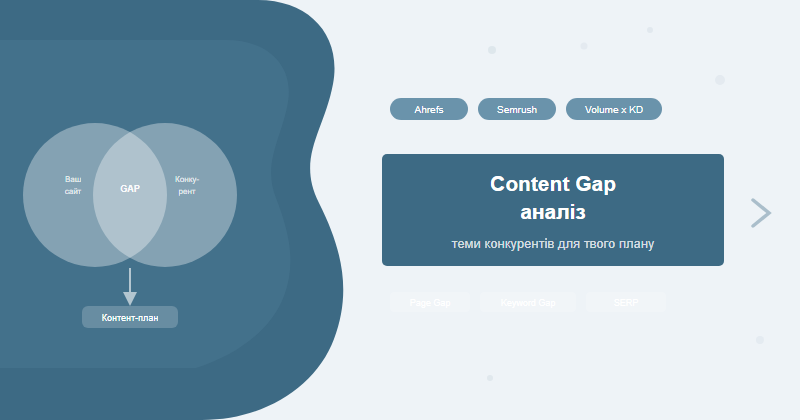
Content gap analysis identifies queries where competitors rank and your site does not — a faster route to a content plan than keyword research from scratch because demand is already proven. According to Ahrefs data, 90.63% of pages get zero organic traffic from Google, most of them because they simply don't cover what searchers are looking for.
Contents
- What is content gap analysis and why it beats starting from scratch
- Types of gaps: Page Gap vs Keyword Gap
- Content Gap in Ahrefs: step-by-step
- Keyword Gap in Semrush: the same idea, different UI
- Ahrefs vs Semrush for Content Gap: which to use
- Prioritising gap keywords: the Volume × KD matrix
- SERP analysis before writing: what to check
- Refresh vs New: when to update instead of create
- From analysis to content plan: template and logic
- FAQ
What is content gap analysis and why it beats starting from scratch
The traditional approach to content strategy is to build a keyword list from zero using Keyword Planner or Ahrefs Keywords Explorer. It gives broad coverage but doesn't answer the key question: which topics are already bringing traffic to competitors right now?
Content gap analysis flips the logic: look at the competitor first, then compare against yourself. The overlap report surfaces specific gaps — queries with proven demand where you have no content or weak content. In our work with new clients, a two-week gap analysis typically uncovers 80 to 400 gap keywords, most of them already grouped into natural topic clusters without extra effort.
Don't confuse the two: Content Gap is about missing topics and pages. Competitive Gap is about overall domain visibility. Content Gap is specific to URLs and queries; Competitive Gap is about domain authority and link profiles.
Types of gaps: Page Gap vs Keyword Gap
There are two fundamentally different types of content gaps, and the fix for each is different.
Page Gap — a competitor has a dedicated page on a topic you haven't covered at all. For example, they have a full guide on "How to do an SEO audit yourself" and your site doesn't address the topic. The fix: create a new page.
Keyword Gap — you have a relevant page, but it doesn't rank in the top 20 for a query where the competitor sits in the top 5. For example, your SEO audit article exists but doesn't rank for "technical site audit checklist". The fix: update and optimise the existing page.
| Gap type | Situation | Fix | Priority |
|---|---|---|---|
| Page Gap | Topic missing from site | Create a new page | Medium — requires new content |
| Keyword Gap | Page exists but not ranking | Update + optimise | High — faster results |
In practice, Keyword Gap delivers faster ROI: you're updating an already-indexed page, and it often climbs to the top 10 within 2–6 weeks. Page Gap is a longer-term content production plan.
Content Gap in Ahrefs: step-by-step
Ahrefs has a built-in Content Gap report that automatically compares your domain against competitor domains and returns the keywords where they rank but you don't.
- Open Site Explorer → enter your domain in the search bar.
- Select Content Gap in the left menu under "Organic search".
- Add competitors — enter 3 to 5 competitor domains. Set the intersection to "At least 2 targets rank" or "At least 3 targets rank" depending on how many competitors you added.
- Click Show keywords — Ahrefs returns a list of keywords with Volume, KD, and competitor positions.
- Filter the results:
- Volume: 50+ (removes zero-volume noise)
- KD: under 30–40 to start
- Exclude branded terms for each competitor
- Export to CSV — for clustering in a spreadsheet.
Practical tip: if you set the filter to "1 of 3 targets rank", the list will be huge and noisy. "2 of 3" or "3 of 5" is the sweet spot — it returns queries with real niche demand rather than one-off competitor experiments.
Keyword Gap in Semrush: the same idea, different UI
Semrush delivers the same functionality through its Keyword Gap tool. The approach differs in how intersection types are defined and how results can be clustered.
- Go to Keyword Gap under "Keyword Research" → "Keyword Gap".
- Enter your domain and up to 4 competitors. Select country and Organic search type.
- Choose the intersection type. Semrush offers several options:
- Missing — keywords where ALL competitors rank but you don't. Usually the most valuable filter.
- Weak — you rank but in positions 11–20, while competitors hold top 10.
- Untapped — keywords from at least one competitor that you're missing.
- Filter by Volume and KD, sort by Search Volume descending.
- Cluster the results using the built-in Keyword Clustering tool or manually in a spreadsheet.
"Missing" in Semrush is the strictest filter: every competitor covers the topic and you don't. Start your content plan here.
Ahrefs vs Semrush for Content Gap: which to use
| Parameter | Ahrefs Content Gap | Semrush Keyword Gap |
|---|---|---|
| Keyword database | 28B+ keywords (global) | 25B+ keywords (global) |
| Competitors allowed | Up to 10 domains | Up to 5 domains |
| Intersection types | All targets / At least N | Missing / Weak / Untapped / Unique |
| Clustering | Manual or via Keywords Explorer | Built-in Keyword Clustering |
| Audit integration | Site Audit + Content Gap together | Keyword Gap separate from audit |
| Filter flexibility | Simpler filters, less granularity | More detailed intersection types |
| Starting price | From $129/mo | From $139.95/mo |
In practice we often combine both tools: Ahrefs gives a deeper positional picture, Semrush makes gap classification more granular. If you only have one subscription — use Ahrefs for technical depth or Semrush when you need quick clustering.
Prioritising gap keywords: the Volume × KD matrix
After exporting, you can have anywhere from 200 to 2,000 gap keywords. Tackling everything at once is a mistake. Prioritise by two core metrics: search volume and keyword difficulty (KD).
Priority score formula: Volume × (100 − KD). High-volume, low-KD keywords come first. High-volume, high-KD keywords go into the long-term plan.
In numbers: a keyword with Volume 1,000 and KD 20 scores 80,000. A keyword with Volume 2,000 and KD 70 scores only 60,000 — lower priority despite the bigger search volume. We use this scoring for clients launching new blogs; it consistently produces first rankings within 4–8 weeks.
SERP analysis before writing: what to check
Before locking a gap topic into the content calendar, review the SERP for each keyword cluster. A competitor's ranking alone doesn't guarantee your article will replace them — the SERP may show a completely different intent.
- Content type in the top 10: if videos or category pages dominate, a long-form article is unlikely to rank.
- Content format: long guide, checklist, comparison table, short answer snippet. Match the dominant format.
- Coverage depth: scan the top 3 pages — how deep do they go? Are there sub-topics they skip that you could own?
- Featured Snippet: if one exists, write a direct answer in the first paragraph or in a table to capture it.
- Age of top results: if the top-ranking page hasn't been updated in 2+ years, fresh content with better depth can outrank it.
Check whether Google shows an AI Overview for the query. If yes, structure your content around direct sub-question answers — AI Overviews pull exactly those blocks for citations.
Refresh vs New: when to update instead of create
One of the most common mistakes during Content Gap work is automatically scheduling new pages for every gap cluster. First check: do you already have a page that partially ranks for these queries?
If a page exists and sits at positions 11–30, updating it is more efficient than publishing something new. The existing page carries accumulated authority and inbound links. In our experience, refreshing outdated pages drives 30–80% traffic growth within 3–6 weeks without building a single new link.
When to update an existing page:
- Page ranks positions 11–50 for the gap keyword
- Page covers the topic but the gap keyword isn't used in the title or body
- Content is more than 18 months old and hasn't been refreshed
- The top-ranking competitor uses the same format (article vs article)
When to create a new page:
- The topic doesn't exist on the site at all (Page Gap)
- A page exists but targets a different intent or audience
- The cluster is too large to fit on one page without cannibalisation
From analysis to content plan: template and logic
Once you've prioritised and checked the SERPs, organise gap keywords into a content plan. Here is the minimal working template:
| Topic / H1 | Primary keyword | Volume | KD | Type | Priority |
|---|---|---|---|---|---|
| What is Content Gap Analysis | content gap analysis | 1,200 | 18 | New page | 1 |
| Keyword Gap vs Content Gap | keyword gap | 880 | 24 | New page | 1 |
| Technical SEO Audit Checklist | technical site audit | 2,400 | 38 | Refresh | 2 |
| Semantic Core: Keyword Clustering | keyword clustering | 590 | 15 | New page | 1 |
| Internal Linking for SEO | internal linking | 320 | 20 | New page | 3 |
Add columns for: Publish date, Owner, Status (in progress / done / published). For multi-language sites, duplicate rows with a language tag. Notion, Airtable, or a simple Google Sheet all work well for managing this plan.
Content gap analysis works alongside two related processes — read our guides on building a semantic core and running a technical SEO audit to get the full picture before writing new content.
For an authoritative deep-dive on the method, see the Content Gap Analysis guide on the Ahrefs Blog.
FAQ
What is content gap analysis?
Content gap analysis is the process of comparing your site's content against competitors to find queries where they rank and you don't. The result is a ready list of topics with proven search demand.
What is the difference between Page Gap and Keyword Gap?
Page Gap means a competitor has a page on a topic you haven't covered. Keyword Gap means you have a relevant page but it doesn't rank for a query where the competitor holds a top-10 spot.
How do I run a content gap analysis in Ahrefs?
Open Ahrefs → Site Explorer → your domain → Content Gap. Enter 3–5 competitor domains, set the filter to "at least 2 targets rank", run the report, export the CSV, and cluster the keywords by intent.
Do I always need to create a new page for a gap keyword?
No. If a relevant page already ranks at positions 11–50, refresh it first: add the keyword to the title, expand the relevant section, add tables or a FAQ. A new page is only warranted when no matching page exists or the intent is fundamentally different.
How many competitors should I add to a Content Gap report?
3–5 is the sweet spot. Fewer and the keyword list is too narrow. More and you get noise from irrelevant niches. Choose direct search competitors — sites that appear in the top 10 for your primary keywords — not just similar businesses.
How often should content gap analysis be repeated?
Quarterly at minimum. Competitors publish continuously, so gaps shift. In fast-moving markets, every 6–8 weeks. After major Google algorithm updates, run it out of cycle to catch any reshuffling in the SERPs.
Can content gap analysis be done without paid tools?
Partially. Google Search Console shows queries where you rank outside the top 10 but still appear. Manual SERP comparison for your top keywords reveals competitor topic clusters. A full gap report with Volume and KD data, however, requires Ahrefs, Semrush, or an equivalent tool. Ahrefs Webmaster Tools (free) provides limited gap data for your own domain.
Want to know which topics your competitors cover that you don't?
SEO-Factory runs Content Gap analysis and builds prioritised content plans based on traffic potential. Also see how Google evaluates content expertise before you plan new material.