
Your shopping cart is empty!
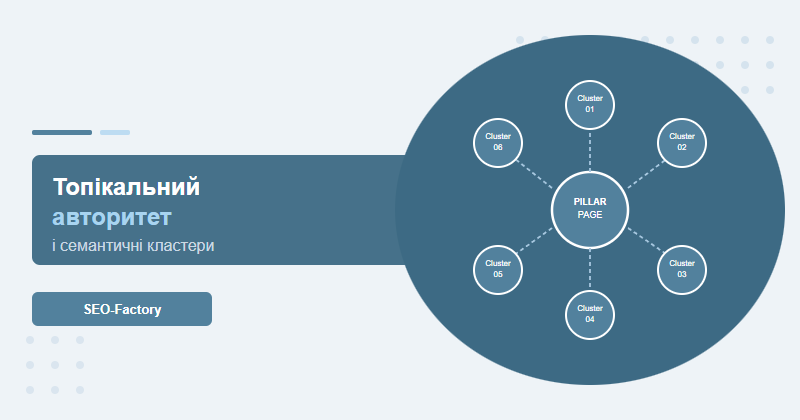
Topical authority is Google's confidence that your site is an expert source on a specific subject. Sites with strong topical authority rank more easily for any query in their niche — even without acquiring new backlinks. The foundation is a cluster architecture built on pillar pages, cluster pages, and strategic internal linking.
Contents
- What is topical authority
- Why Google ranks topical authorities higher
- Semantic clusters: pillar and cluster pages
- How to build a cluster architecture
- Internal linking between clusters
- Tools: Ahrefs, SurferSEO, Clearscope
- Measuring topical authority
- Common mistakes when building clusters
- Frequently asked questions
What is topical authority
Topical authority is the concept by which Google evaluates not just individual pages but an entire site as a coherent knowledge source within a subject area. When a site systematically and thoroughly covers a topic — from foundational concepts to nuanced details — the algorithm begins to "trust" it and automatically boosts the ranking potential of new pages, even when those pages have few inbound links.
The concept gained widespread attention after Google's Helpful Content and Spam Updates of 2023–2024, which shifted the emphasis from link quantity to genuine content depth and value. But the underlying idea is older: back in 2012, Google's Amit Singhal discussed the importance of subject-matter authority as a ranking signal.
In practical terms: if you run a cybersecurity blog with 80 in-depth articles covering threats, compliance, pen testing, and cloud security — a new post about zero-day vulnerabilities will climb the rankings faster than the same article on a site with only 5 security posts.
Core principle: Topical authority is not a single number — it is a systemic property of your site that builds over months. Building semantic clusters is the most effective way to develop it deliberately.
Why Google ranks topical authorities higher
Google's goal is to surface the most complete and reliable answer for every query. A site that covers a topic systematically sends multiple positive signals to the algorithm at once:
- Semantic coverage: A large number of related pages shows Google that you address all subtopics without leaving gaps.
- Behavioral signals: Genuinely useful content keeps readers engaged longer, reduces bounce rate, and encourages navigation between pages.
- Internal links: Dense, purposeful internal linking transfers PageRank between related pages and helps crawlers understand the topical structure.
- E-E-A-T signals: In-depth content with real examples, data, and clear authorship demonstrates experience and expertise.
- CTR and satisfaction: When users consistently choose your results in the SERP, that is a positive ranking signal in itself.
"Sites that are authoritative for a given topic receive a ranking advantage for queries on that topic." — from Google's patent on source authority evaluation systems.
We have seen this firsthand: after building a cluster of 12 pages around "technical SEO audit," the pillar page moved from position 19 to position 4 within four months — with no new external links added. The driver was increased topical coverage and a denser internal linking structure.
Topical authority does not replace backlinks entirely. But it enables you to compete with stronger domains in niches where your site covers the subject more comprehensively than a competitor with a higher DR.
Semantic clusters: pillar and cluster pages
A semantic cluster is a group of interconnected pages that collectively cover a single topic. The structure revolves around two types of pages.
Pillar page
A pillar page is a broad overview of the topic. It introduces all subtopics at a summary level and serves as the central hub of the cluster. Typical characteristics:
- Length: 2,000–4,000 words
- Target keyword: broad, head-term query (e.g., "e-commerce SEO")
- Structure: overview of subtopics with links to detailed cluster pages
- Goal: rank for the main keyword and distribute authority throughout the cluster
Cluster pages
Cluster pages are detailed pieces covering a specific subtopic. Each page addresses exactly one search intent:
- Length: 1,000–2,500 words
- Target keyword: specific, long-tail query (e.g., "technical SEO audit for e-commerce stores")
- Structure: deep dive into a single subtopic
- Goal: rank for long-tail queries and reinforce the pillar page
| Parameter | Pillar Page | Cluster Page |
|---|---|---|
| Topic breadth | Wide (entire topic) | Narrow (one subtopic) |
| Depth | Introductory (overview of subtopics) | Deep (detailed analysis) |
| Length | 2,000–4,000 words | 1,000–2,500 words |
| Target queries | Broad (head terms) | Specific (long-tail) |
| Internal links | Links to all cluster pages | Links to pillar + adjacent clusters |
Example cluster for an SEO agency:
- Pillar: "SEO Strategy: The Complete Guide"
- Cluster 1: "Technical SEO Audit: Step-by-Step Guide"
- Cluster 2: "Keyword Research and Semantic Clustering"
- Cluster 3: "Internal Linking and Site Architecture"
- Cluster 4: "Link Building: Building Your Backlink Profile"
- Cluster 5: "Core Web Vitals and Technical Optimization"
How to build a cluster architecture
Building a cluster architecture is a systematic process that takes two to four weeks for the first cluster. Here is the step-by-step approach we use at SEO-Factory.
Step 1. Audit your existing content
Before creating new pages, evaluate what you already have. Run a crawl audit using Screaming Frog or Ahrefs Site Audit:
- Identify pages already ranking for topical queries
- Find cannibalization issues — multiple pages competing for the same keyword
- Flag thin-content pages (under 300 words) for expansion or consolidation
Practical rule: If three or more pages target similar queries, that is a cannibalization signal. Consolidate them into one comprehensive cluster page.
Step 2. Collect and cluster keywords
For each target topic, gather all related queries using Ahrefs Keyword Explorer, Google Search Console, and the "People also ask" boxes in the SERP. Aim for a list of 50–200 queries per topic.
Group queries by search intent:
- Informational — "what is X," "how does X work" → blog posts, guides
- Commercial — "best X," "X pricing," "X vs Y" → comparison pages, service pages
- Navigational — "X official site" → homepage, brand page
- Transactional — "buy X," "download X" → product pages, forms
Step 3. Map pillar and cluster pages
From the full query list, select one broad query for the pillar page and 5–15 specific queries for individual cluster pages. The criterion: each cluster page must have a distinct search intent that does not overlap with the pillar or with other cluster pages.
Step 4. Write the content
Start with the pillar page, then write cluster pages. For each page:
- Analyze the top 10 competitors in the SERP for that specific query
- Identify content gaps — topics competitors cover that you do not
- Add unique data: case studies, statistics, first-hand experience
- Optimize for NLP — incorporate semantically related terms and LSI keywords
Step 5. Set up internal linking
After all cluster pages are published, configure the internal linking structure (covered in detail in the next section).
Step 6. Repeat for additional clusters
A site can support 3–10 thematic clusters. Once the first cluster is built, move to the next topic. Cross-cluster linking also matters — connect clusters through "thematic bridge" pages where topics naturally intersect.
Internal linking between clusters
Internal linking is the structural backbone of topical authority. It serves three purposes simultaneously: transferring PageRank between pages, helping crawlers map your topical structure, and improving UX through logical navigation.
Linking model within a cluster
The correct pattern looks like this:
- Pillar → Cluster: the pillar page links to every cluster page in the cluster (5–15 links)
- Cluster → Pillar: each cluster page includes one link back to the pillar page
- Cluster → Cluster: adjacent cluster pages link to each other (2–4 cross-links)
Important: Avoid "flat" linking where all pages simply point to each other without hierarchy. Crawlers should see a clear structure: pillar at the center, cluster pages as spokes.
Linking between clusters
When a site has multiple clusters, connect them through "thematic bridges" — pages or sections where topics naturally overlap. For example:
- "Technical SEO" cluster ↔ "Core Web Vitals" cluster — bridged by a page on page speed optimization
- "Content Marketing" cluster ↔ "Link Building" cluster — bridged by a page on linkable assets
Anchor text
Use descriptive, keyword-rich anchors for internal links, but avoid exact-match anchors on every link:
- Good: "our step-by-step technical audit guide," "how to build a semantic keyword cluster"
- Avoid: "click here," "learn more," "read this"
For a deeper look at site architecture and link flow, see our article on internal linking and site architecture.
How many internal links per page?
Google advises keeping the number of links on a page reasonable. In practice, 5–20 internal links per 1,500–3,000-word content page works well. Pillar pages can carry up to 30–40 links given the volume of subtopics they cover.
Tools: Ahrefs, SurferSEO, Clearscope
The three main tools for topical authority have different focal points but complement each other well.
Ahrefs Topic Explorer
Ahrefs is the most comprehensive tool for analyzing topical authority at the domain level. Key features:
- Topic Explorer — reveals which subtopics within a niche your site has not yet covered
- Content Gap — compares your content with competitors and surfaces semantic gaps
- Topical Authority Score — Ahrefs' proprietary metric for gauging topical authority
- Site Explorer → Top Pages — identifies which pages are already driving authority in your niche
For methodology and strategy recommendations, see Ahrefs' in-depth guide on topical authority — it covers how the metric is calculated and how to close coverage gaps.
SurferSEO
SurferSEO focuses on on-page optimization and semantic coverage for individual pages:
- Content Editor — shows which NLP terms to include for maximum semantic coverage of a given topic
- Topical Map — automatically generates a cluster map for a chosen niche
- Content Audit — identifies pages losing rankings due to outdated or thin content
- SERP Analyzer — breaks down the top 10 and surfaces structural ranking patterns
Clearscope
Clearscope is a content optimization platform at the topic level — particularly useful for editorial teams:
- Topic Score — grades semantic coverage from A+ to F
- Related Terms — surfaces terms to weave into the text for full topic coverage
- Competitor Analysis — benchmarks your content against top-ranking competitors by semantic richness
| Tool | Primary Focus | Best For | Price/mo |
|---|---|---|---|
| Ahrefs | Niche and competitor analysis | Strategic cluster planning | from $129 |
| SurferSEO | On-page optimization | Writing individual pages | from $89 |
| Clearscope | Semantic text coverage | Editorial teams with 10+ writers | from $189 |
For most projects, Ahrefs (strategy) plus SurferSEO (on-page) is sufficient. Clearscope becomes worthwhile for larger editorial operations where consistency across many writers matters.
Measuring topical authority
Topical authority is not captured by a single metric — it requires a dashboard of indicators tracked together. Here is what we monitor at SEO-Factory.
Topical coverage metrics
- Keywords ranking in the top 10: how many queries from the topic are on page one
- Topic coverage percentage: share of subtopics for which you have content (calculated in Ahrefs Topic Explorer)
- Average cluster position: mean ranking across all pages in a given cluster
Traffic and engagement metrics
- Organic traffic to thematic pages: 3–6 month trend line
- Time on page: content quality indicator (benchmark for guides: 3–5 minutes)
- Pages per session: how many cluster pages a single user visits in one session
Technical metrics
- Internal PageRank distribution: how link equity flows across pages (analyzed in Screaming Frog)
- Crawl depth: how many clicks from the homepage to reach cluster pages (target: no deeper than 3)
- Orphan pages: pages with no internal links pointing to them (target: zero)
Measurement cadence: Review these metrics monthly. The first meaningful results from a new cluster typically appear after 60–90 days. Avoid drawing conclusions earlier — Google needs time to reassess domain authority in light of new content.
Competitive benchmarking
Run a quarterly comparison against your top competitors on topical authority metrics:
- How many pages does the competitor have on your topic?
- Which subtopics do they cover that you do not?
- What is the average length and quality of their cluster pages?
- How dense is the internal linking within their clusters?
For position tracking across a cluster, Google Search Console remains the most granular free tool. Read our complete Google Search Console guide for setup and interpretation tips.
Common mistakes when building clusters
Based on our work across dozens of projects, the same mistakes keep appearing when teams attempt to build topical authority.
1. Keyword cannibalization
The most widespread problem: multiple pages competing for the same keyword. Google cannot determine which page to rank, so neither reaches the top. The fix is content consolidation or canonical tag configuration.
For a full breakdown of how to diagnose and resolve cannibalization, see our article on canonical tags: setup and common errors.
2. Orphan pages with no internal links
Pages that receive no internal links are effectively invisible to crawlers and contribute nothing to cluster authority. Audit for orphan pages regularly — a single crawl in Screaming Frog surfaces them in seconds.
3. A pillar page that is just a link list
A pillar page must deliver standalone value: a topic overview, comparison tables, key takeaways. If it reads only as a navigation menu with no real content, Google will not rank it. The bar is 2,000+ words of genuinely useful text.
4. Ignoring search intent
Each cluster page must match the actual search intent of its target query. Writing an informational guide for a query with transactional intent — or a product page for an informational query — is one of the fastest ways to waste content budget. Always check the SERP before writing.
5. No content refresh cadence
Cluster architecture is not a one-time project. Content needs regular updates: refreshed statistics, new case studies, expanded subtopics. Google rewards freshness, especially in fast-moving niches like SEO, tech, and finance. Build a quarterly review into your content calendar.
6. URL structure that obscures hierarchy
URLs should reflect topical hierarchy so Google understands the structure at a glance:
- Pillar:
/seo-guide/ - Cluster:
/seo-guide/technical-audit/,/seo-guide/link-building/
A flat URL structure like /technical-audit/ and /link-building/ with no parent signals does not communicate the relationship between pages.
Frequently asked questions
What is topical authority in SEO?
Topical authority is Google's assessment of how comprehensively a website covers a specific subject area. The more thoroughly you address queries in your niche, the higher the authority Google assigns — and the easier it becomes to rank for new keywords within that topic.
How many pages does a semantic cluster need?
A minimum cluster consists of a pillar page plus 4–6 cluster pages. For competitive niches, we recommend 8–15 pages per cluster. What matters most is the quality and completeness of subtopic coverage, not a fixed page count.
How do you measure a website's topical authority?
Use Ahrefs Topic Explorer (Topical Authority metric), SurferSEO Content Audit, and Clearscope Topic Score. Also track the number of keywords ranking in the top 10 for your topic and the organic traffic trend across thematic pages.
How does a pillar page differ from a regular blog post?
A pillar page is a broad 2,000–4,000-word overview of a topic that introduces all subtopics and links to detailed cluster pages. A regular article dives deep into a single subtopic but does not attempt to cover the entire niche comprehensively.
Build topical authority with SEO-Factory
We design cluster architectures, write pillar and cluster pages, and configure internal linking — so your site becomes the go-to expert source in your niche.
Get a website promotion quote