
Your shopping cart is empty!
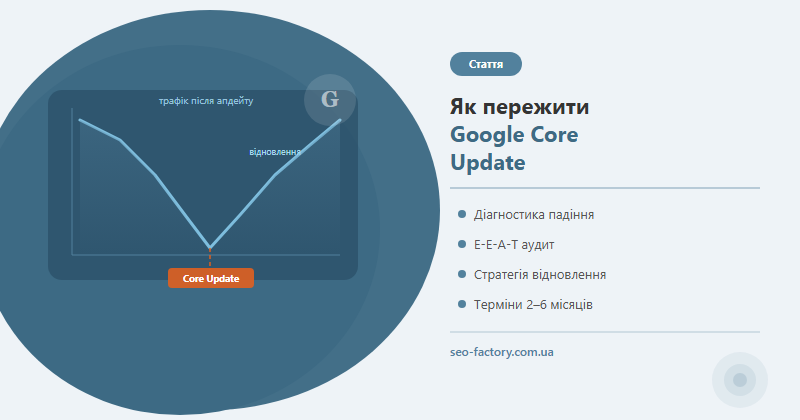
Google Core Updates arrive 4–6 times a year and re-evaluate the quality of hundreds of thousands of sites each time. If your traffic dropped, here is how to diagnose the cause and build a concrete recovery plan.
Table of Contents
- What is a Core Update and how it differs from other updates
- Why traffic drops: three real scenarios
- Core Update timeline: what to know for planning
- How to identify it: diagnosing a Core Update drop
- What NOT to do during a rollout
- Recovery strategy: a step-by-step plan
- SEO-Factory case study: recovering after a Core Update
- Preparation checklist for the next Core Update
- Frequently asked questions
What is a Core Update and how it differs from other updates
Google makes thousands of minor algorithm tweaks every day — most go unnoticed. A Core Update is different. It is a broad re-evaluation of how the algorithm understands content quality, site authority, and alignment with search intent. It happens several times a year, and the rollout takes anywhere from 7 to 14 days.
The critical distinction: Core Updates do not penalise for specific violations. They shift the weight of hundreds of signals. A site that did nothing "wrong" can still lose rankings — simply because competitors, or new entrants, showed Google a better answer to those queries.
One important milestone: in March 2024, Google folded the Helpful Content Update into Core Updates. There is no longer a separate HCU signal — content helpfulness is now evaluated as part of the overall algorithm. If your site was hit by the August 2023 HCU, the causes and fixes are the same framework.
Why traffic drops: three real scenarios
When Google announces a Core Update, the SEO community immediately hunts for "what exactly changed." The reality is that a Core Update is not one change but a bundle of dozens or hundreds of adjustments. In practice, however, most post-Core-Update traffic drops fall into three scenarios.
1. Re-calibration of E-E-A-T signals in your niche
Google constantly refines its understanding of what authoritative content looks like in a specific vertical. In medical, financial or legal topics (YMYL), a Core Update can sharply increase the weight of genuine authorship signals — named authors, references from established industry sources, and verified credentials.
If your site published useful content but without clear authors, without external references, and without a real "face" behind the material — Core Update may have redistributed visibility to competitors that do show those signals.
2. Shifted understanding of search intent
Sometimes a Core Update changes how Google interprets specific queries. A query like "best laptops for students" may have been satisfied by long-form comparison articles in the past. After the update, Google decided the user wants "a fresh seasonal ranking" — and deprioritised evergreen pieces in favour of regularly updated lists.
You did not violate anything. Your content did not get worse. Google simply re-evaluated what the user is actually looking for.
3. New or strengthened competitors
A Core Update does not always "hit" you — sometimes it simply "lifts" someone else. A younger site with fewer pages but very strong E-E-A-T in a narrow topic may have received a significant boost, automatically eating into your share of visibility.
Practical rule: if traffic dropped 10–20% evenly across the whole site, the likely cause is a broad E-E-A-T re-evaluation. If specific topic clusters fell, the issue is intent shift or competitor strengthening in those exact themes.
Core Update timeline: what to know for planning
Google publishes an official update history log. Understanding the cadence of Core Updates helps you plan recovery windows and anticipate the next cycle.
Key facts about the Core Update rhythm:
- 2–3 months between updates — the average interval. This is your fix window.
- 7–14 day rollout — rankings fluctuate during this period. Volatility is normal; panic is counterproductive.
- Fixes don't work instantly — Google will only re-evaluate your improvements at the next Core Update.
- Some rollouts run long — the March 2024 Core Update took a record 45 days.
How to identify it: diagnosing a Core Update drop
The first step after a visible traffic drop is to establish whether it's connected to a Core Update — or something else entirely (a technical failure, manual action, or seasonality).
Step-by-step diagnosis
- Match the drop date to the update calendar. Open Google Search Console → Performance → Compare. Cross-reference with the official Google update history. A match within a week strongly points to Core Update.
- Check the "Manual actions" tab in GSC. If there is one, it is a separate issue — not Core Update.
- Segment the drop in GSC. Did it affect all pages or a specific cluster? Which queries lost rankings?
- Check competitors. In Semrush or Ahrefs: did competitors grow on those same dates? If yes, it is a redistribution of visibility, not a technical problem.
- Analyse who replaced you. Who took your rankings? What is their page structure, authorship, backlink profile?
Running a technical SEO audit beforehand helps rule out technical causes before you move into content analysis.
What NOT to do during a rollout
The rollout window — 7 to 14 days — is a period of deliberate instability. Rankings fluctuate. Traffic numbers are unreliable. Several common reactions make the situation worse, not better.
| Mistake | Why it backfires |
|---|---|
| Mass-deleting or rewriting content | Google has not finished its evaluation. You risk removing content that was not actually causing the drop |
| Redirecting affected pages | You lose accumulated PageRank and the underlying problem remains |
| Buying links to "compensate" | Artificial link velocity during an update is a SpamBrain risk |
| Waiting for Google's official explanation | It will not come. There are only general E-E-A-T principles |
| Deploying CMS or hosting changes | Hard to separate Core Update effects from self-inflicted technical changes |
The rollout rule: collect data, change nothing until the rollout is fully complete. Then analyse and plan. Actions come only after positions stabilise.
Recovery strategy: a step-by-step plan
Once the rollout is over and positions have stabilised, the real work begins. Recovering from a Core Update is not about fixing one thing — it is a systematic effort across several parallel tracks.
Step 1. Content audit of affected pages
Identify the top 20 pages with the greatest traffic drop. For each, answer:
- Who authored this piece? Is there an author bio with a real profile or credentials?
- Does the content match the actual search intent for this query today?
- Does the page contain unique information that cannot be found on 10 other sites?
- Is the content backed by primary sources and citations?
- When was it last updated? Is the information still current?
For a deeper look at how to evaluate authority signals correctly, see our article on E-E-A-T and how Google evaluates expertise and trust.
Step 2. Strengthening E-E-A-T signals
E-E-A-T (Experience, Expertise, Authoritativeness, Trustworthiness) is not a single metric but a collection of concrete signals Google pulls from multiple sources.
- Experience: add first-hand case examples with specific dates and results. "We implemented this for a client in Q3 2024 and saw +34% organic traffic within 4 months" — that is experience.
- Expertise: name authors with links to their profiles; add a real "Meet the team" page with photos and credentials.
- Authoritativeness: earn mentions on industry publications; display awards, media citations, or speaking engagements.
- Trustworthiness: clear contact information, legal details, SSL, verified reviews (Google Business, Trustpilot).
Step 3. Revising semantics and content structure
If Core Update shifted how Google interprets intent, rewriting text alone will not fix the problem — you need to rethink what page Google wants to see for a given query. Audit the current top 10 for your target queries:
- What format do the winners use: article, list, video, comparison?
- What length and structure?
- What sub-queries do they cover?
Revisiting your keyword semantic core and clustering helps answer these questions at scale, not one page at a time.
Step 4. Technical SEO clean-up
Core Updates do not directly penalise technical issues — but technical debt amplifies the negative effect. After the content audit, check:
- Core Web Vitals in GSC: any pages with "Poor" status?
- Internal linking: are all key pages reachable within 2–3 clicks?
- Duplicate and thin content: is it diluting topical authority?
- Mobile usability: test in the GSC Mobile Usability report.
Step 5. Targeted link acquisition for affected pages
If the competitors that displaced you have a stronger backlink profile in your niche — that is part of the equation too. Not mass link building, but targeted: 5–10 quality links from authoritative industry sources pointed at your key pages.
SEO-Factory case study: recovering after a Core Update
In our practice at SEO-Factory — a project in the financial services niche that experienced roughly a 38% drop in organic traffic following one of the 2024 Core Updates. Diagnosis revealed a combination of factors.
What we found
- 60% of articles had no named author — or the author field said "editorial team" with no profile.
- Around 40 thin pages (under 400 words) were cannibalising each other's traffic.
- A technical audit uncovered 120+ pages without unique meta titles.
- Competitors who gained the top spots had named authors with public profiles and verifiable credentials in finance.
What we did
- Added author pages with real photos, short bios, and LinkedIn links. Every article was tied to a specific named author.
- Consolidated: 40 thin pages merged into 12 expanded pieces with original data and client case examples.
- Updated 30 key articles — added concrete numbers, verified sources, and visible "last updated" dates.
- Fixed technical issues and improved Core Web Vitals (LCP from 4.2 to 2.1 seconds).
Result
At the next Core Update, 11 weeks later, traffic recovered by +29% against the pre-drop baseline. Full recovery and a surplus above the original level (+14% above baseline) was reached 5 months after the work began.
The client initially wanted to "just mass-rewrite all articles." We convinced them to audit first — and it turned out 60% of the content didn't need rewriting at all. The problem was not the text; it was missing authorship and accumulated technical debt.
Preparation checklist for the next Core Update
The best time to prepare for the next Core Update is not when your traffic has already dropped — it is right now, during a stable period. Here is what to review and fix proactively.
| Area | Action | Priority |
|---|---|---|
| E-E-A-T / Authorship | Add a named author with a real profile to every article | High |
| E-E-A-T / Authorship | Create or update an "About the team" page with real photos and bios | High |
| Content | Audit thin-content pages (under 500 words) | High |
| Content | Update dates and accuracy on key evergreen articles | Medium |
| Content | Consolidate cannibalising pages | Medium |
| Technical SEO | Core Web Vitals — all key pages in "Good" status | High |
| Technical SEO | Unique title and description on every page | Medium |
| Links | Review and disavow toxic backlinks | Medium |
| Links | Earn 5–10 topical links to key pages from authoritative sources | Medium |
| Trust | Up-to-date contact details, legal information, verified reviews | Low |
Track the dates: bookmark the official Google update history page or follow @googlesearchc for announcements. Knowing the exact rollout start date means you can read your GSC data accurately.
Frequently asked questions
What is a Google Core Update?
A Google Core Update is a broad change to Google's main search algorithm released 4–6 times per year. It re-evaluates content quality across niches using E-E-A-T criteria and does not target specific violations — it shifts the balance of signals that determine what counts as the best answer to a query.
What should I do if my traffic dropped after a Core Update?
Wait for the rollout to finish (7–14 days) and avoid sweeping changes during that window. Once positions stabilise: match your drop to the update calendar, identify affected pages, run an E-E-A-T content audit, strengthen expertise signals, and fix technical issues. You will see the impact of your fixes at the next Core Update.
How long does recovery from a Core Update take?
Realistically, 2–6 months depending on the scale of the problems. Minor drops may recover at the next Core Update in 2–3 months. Serious E-E-A-T or structural content problems may require 2–3 update cycles.
How is Core Update different from Helpful Content Update?
Since March 2024, the Helpful Content Update has been merged into Core Update — there is no longer a separate HCU signal. Core Update now encompasses the helpfulness evaluation alongside broader E-E-A-T re-calibration across all niches.
Does Google give specific guidance after a Core Update?
No — Google does not disclose which sites were affected or why. Diagnosis is your responsibility or that of your SEO team. Use GSC data, compare with competitors in Semrush or Ahrefs, and evaluate E-E-A-T signals systematically.
Can you recover faster between Core Updates?
Technically possible if Google runs unscheduled tests or smaller updates between the main ones. But it is not something to plan around. Design your fix cycle for the next Core Update and use the interim period for thorough preparation.
Did your traffic drop after a Core Update?
SEO-Factory will diagnose the root causes and build a recovery strategy with clear milestones and timelines.