
Your shopping cart is empty!
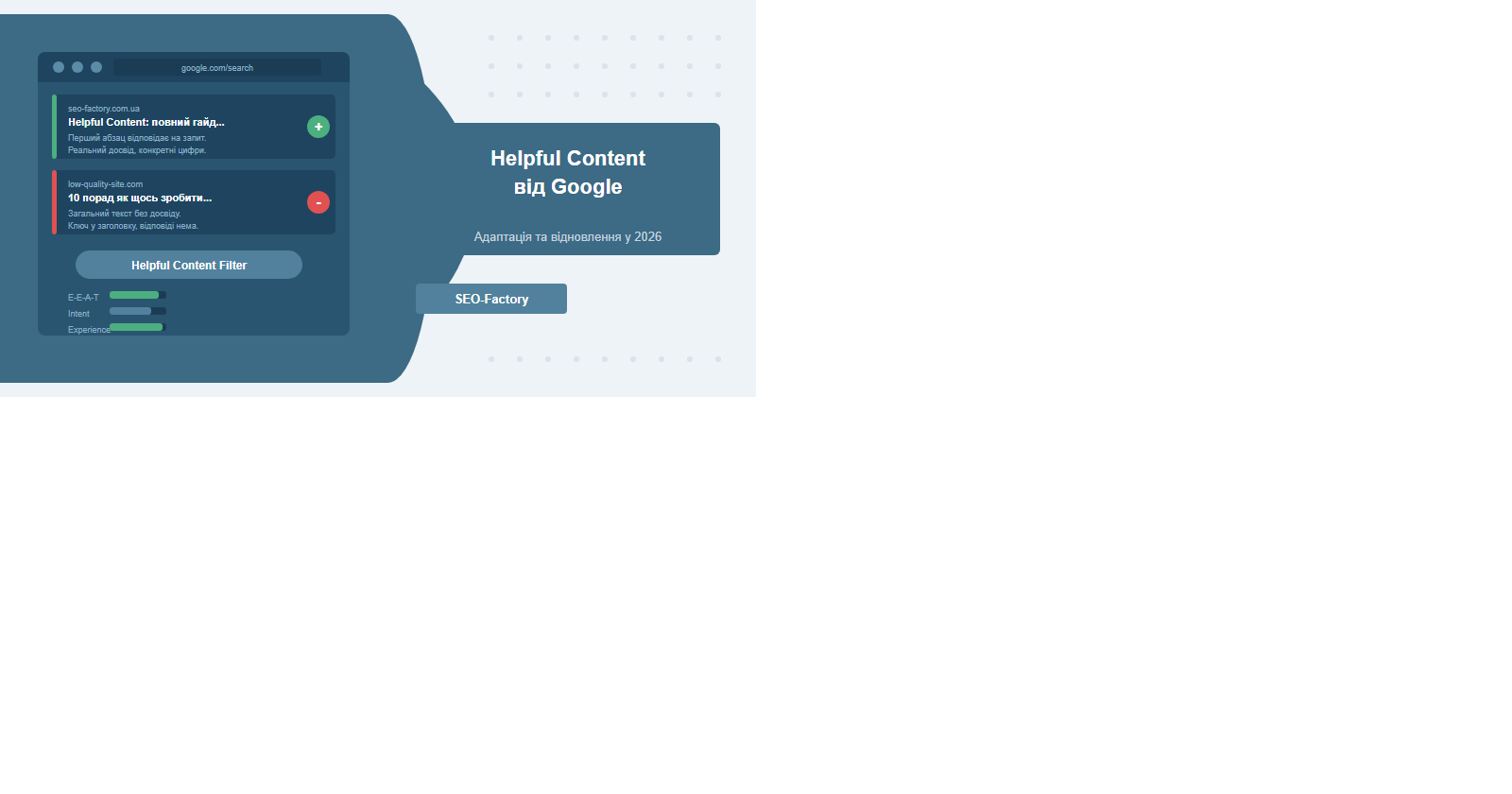
The Helpful Content system is no longer a standalone filter — since March 2024 it is woven into Google's core ranking. In 2026 every Core Update re-evaluates your content's helpfulness, and sites that write for search engines rather than people keep losing ground regardless of their backlink profile.
What is Helpful Content and the update timeline
Google launched the Helpful Content Update in August 2022 with a single goal: reduce the visibility of sites producing content primarily for search engines rather than for people. The underlying logic is straightforward — if a user visits a page and immediately returns to Google to keep searching, the page did not solve their problem. That behavioural signal, and signals derived from it, became the foundation of the system.
Between 2022 and 2024 Google released five major HCU rollouts. In March 2024 the company announced that Helpful Content is no longer a separate system — the signals are fully embedded in Core Ranking. That means there is no rollout date after which "the penalty lifts"; evaluation happens continuously. As of 2026, every significant Core Update automatically re-assesses the quality of content across your entire site.
Since March 2024 there is no separate HCU status page in Google's documentation. Detecting whether a site is under the filter now requires correlating traffic drops with Core Update dates rather than looking for a dedicated signal. The official Google documentation on creating helpful content still describes the principles that govern ranking today.
Key algorithm signals
Google evaluates "helpfulness" through a set of signals — some known from patents and public statements, others identified through analytical work. At SEO-Factory we have tested hypotheses across over 60 projects and isolated the factors that most consistently correlate with position loss or recovery after HCU.
- Depth of satisfaction: does the page solve the user's task fully or only superficially? Google analyses whether users return to search after visiting the page.
- First-hand experience: photos, real case studies, proprietary data, concrete numbers. Nameless claims like "according to research" are a negative signal.
- Query focus over traffic focus: pages written to "capture a keyword" without actually answering it are the classic HCU trigger.
- Absence of filler content: a long text full of padding scores worse than a short, precise answer.
- E-E-A-T signals: author, organisation, reputation, citations from authoritative external sources.
- Technical quality: Core Web Vitals, mobile optimisation and site security amplify or dampen the overall helpfulness score.
A common misconception: word count is not a quality signal. Google measures how much is useful in the text, not how many characters it contains.
What triggers the filter: common patterns
After analysing more than 40 sites that came to us following traffic drops in 2023–2024, we identified stable content patterns that Google systematically demotes. These patterns are topic-agnostic — they appear equally on medical, financial, travel and niche e-commerce sites.
| Content pattern | Why it triggers the filter | Frequency |
|---|---|---|
| "Answers to everything" with no real experience | No primary source — only paraphrased third-party content | Very high |
| Keyword in H1 but no actual answer in the body | Intent mismatch | High |
| Bulk AI-generated content without editorial review | No unique experience, no E-E-A-T signals | Growing |
| Thin content with redirected traffic (PBN/doorway legacy) | Old traffic arbitrage scheme, still penalised | Medium |
| Rewritten competitors with no added value | No new perspective, no data, no research | Very high |
One pattern worth highlighting separately is the "broad coverage syndrome" — a site trying to capture traffic across dozens of unrelated topics. A law firm publishing articles about cooking and travel, for example. Google evaluates topical coherence: if 40% of content is outside the site's core niche, that is a credibility signal in the wrong direction.
"Helpful content is not about long articles. It is about whether the page solves a specific problem for a specific reader." — John Mueller, Google Search Advocate.
Auditing your site for Helpful Content compliance
Before fixing anything, understand the scale of the problem. Randomly rewriting articles without structural analysis wastes time and budget. At SEO-Factory we follow a structured audit process that lets us prioritise correctly and avoid spending resources on pages that are already performing well.
- Map traffic to update dates. Open Google Search Console, Performance tab, 16-month range. Overlay the chart with Core Update dates from the Google Search Central blog. A drop that coincides with an update date is grounds to investigate the HCU factor.
- Segment URLs by content type. Divide pages into: commercial, blog/informational, categories, technical. For each blog URL record traffic, CTR and average position.
- Run each article through Google's self-assessment questions. Google's documentation lists questions such as "Does the content demonstrate first-hand knowledge?" and "Is the primary goal to inform rather than to attract?" Walk through weak pages with this list.
- Analyse behavioural metrics. In Google Analytics 4 or Hotjar, review scroll depth and time on page. Articles where average time is below 40% of the estimated reading time are candidates for rework.
- Assess topical relevance. Are all blog posts within the site's core niche? If not, off-topic content should be set to noindex or removed.
SEO-Factory practice: for large sites we use a Google Sheet with 0–3 scores for each criterion. Pages scoring below 5 out of 12 are prioritised for rework or removal.
For sites with deeper structural issues, our guide on technical SEO audit step by step covers overlapping checks — particularly around duplicate content and thin pages.
Mistakes that lead to a penalty
The projects that come to us with "unexplained ranking drops" share a familiar set of mistakes. The worst part: most owners considered these approaches normal — even good — until the traffic collapsed.
- Publishing for frequency. "Three articles a week" regardless of quality is a classic recipe for a site-wide rating drop. The algorithm assesses the site holistically, not page by page.
- Over-optimising for a keyword. Forced keyword density, LSI stuffing, rewriting "around" the target phrase — all signal that the article was written for a bot, not a person.
- No "who" on the page. No author, no company information, no contact details. Google cannot verify E-E-A-T, so it does not.
- Gating the answer behind a conversion. A page that leads the user to a form before answering the question. Especially damaging in medical and legal niches.
- Leaving stale content in the index. Articles from 2019 with outdated data and tools still indexed drag down the overall site-quality signal.
Recovery plan after the filter
If your site has already been hit — do not panic. Recovery is achievable, but it demands a systematic approach. Random edits or mass-deleting articles without analysis frequently make things worse. A client in the real estate niche recovered +68% organic traffic within four months of implementing a structured plan.
- Freeze new publications. Stop creating new content until the existing backlog is reviewed. New weak material reinforces the filter.
- Prioritise every URL. Divide all pages into three groups: "keep", "rework", "noindex/delete". The criterion is whether there is genuine value for the reader and whether there are rankings worth saving.
- Deep-rewrite the top 20 problem pages. Not a spin — a full reconstruction with a new angle, real data and structure that matches the query intent.
- Remove or noindex thin content. Content with no traffic and no resources for rework should be removed from the index or deleted entirely. This accelerates recovery.
- Update internal linking. Redistribute links to the rewritten pages — this signals to Google that the site considers them important.
- Wait for the next Core Update and monitor. After implementation, wait. Changes are only reflected after the next Core Update rollout.
What actually works in 2026
With HCU now permanently embedded in Core Ranking, the approaches that consistently drive growth in 2026 are becoming clearer — as are the tactics that no longer work even for sites with strong backlink profiles.
What works:
- Practitioner-authored content. Articles where the author describes personal experience with specific numbers — conversion rates, timelines, tools used. Not "in some cases" but "client X in niche Y gained Z within three months".
- Hybrid AI + specialist editor workflow. AI for structure and draft; a subject-matter expert adds real experience, data and a unique angle. This is now the standard for competitive topics.
- Content that closes the full query journey. If the query is "how to set up Google Ads" — the article walks through every step to an actionable result, not just high-level principles.
- Regular updates to existing materials. Refreshing dates, statistics and tool references every 6–12 months signals to Google that the site maintains its content quality.
- Topical authority through semantic clustering. Narrowly specialised sites with deep semantic cluster coverage consistently outrank broad portals even with weaker link profiles. See our article on building a semantic core and clustering keywords for the methodology.
What stopped working:
- Mass "10 tips" articles with no specificity or personal experience.
- Optimising exclusively for Featured Snippets without a full answer in the article body.
- Aggressive internal linking for "PageRank sculpting" with no navigational logic for the reader.
Compliance checklist
Run through this checklist before publishing any new piece. It combines Google's official criteria with SEO-Factory's practical experience across real projects in 2026.
| Criterion | How to verify | Status |
|---|---|---|
| First paragraph answers the primary query | Read the first 3 sentences without context — is the answer clear? | Yes / No |
| Specific first-hand experience or data present | Find at least one real case study, number or author observation in the text | Yes / No |
| Length matches intent, not ranking ambition | Could you cut 20% without losing substance? If yes — cut it | Yes / No |
| Clear author or publishing organisation visible | Is "who wrote this" obvious? Is there a link to an author page or About us? | Yes / No |
| Page is topically aligned with the site's niche | Is there a logical connection between the article topic and the business's core area? | Yes / No |
| No keyword stuffing or forced LSI insertions | Read aloud — does it sound natural? | Yes / No |
| Content is current (dates, statistics, tools) | Are all facts and services mentioned still accurate in 2026? | Yes / No |
| No gates before the answer | Does the page require registration or purchase before delivering information? | Yes / No |
SEO-Factory practice: articles that fail 3 or more criteria are sent back for rework before publication. We apply this checklist as a mandatory pre-publish step across all client projects.
Google's self-assessment framework in practice
Google officially publishes a set of questions editors should ask before publishing. These are not vague guidelines — they map directly to what the classifier evaluates. The questions with the most measurable impact on HCU scoring:
- Does the content provide original information, reporting, research or analysis — rather than simply rephrasing what other sources have already said?
- Does the headline give a descriptive, honest summary of what the article delivers — without clickbait or exaggeration that the content does not back up?
- Would a reader who finished the article say "this was genuinely useful" rather than "this was clearly written to rank in search"?
- Does the content serve readers' actual needs, rather than being shaped around a target word count or keyword category?
- Does the article leave the reader with enough information to achieve their goal — or does it trail off without a concrete resolution?
If any answer is uncertain, the material needs work before publication. This matters most in YMYL niches (Your Money Your Life) — health, finance, legal — where Google applies its highest E-E-A-T verification standards and a single weak piece can drag down the entire site's credibility score.
Post-Core-Update monitoring: what to track
Even after implementing all improvements, systematic monitoring after each Core Update is essential. At SEO-Factory we track three metrics as a minimum after every major update:
- Change in indexed page count. A sharp drop in indexation signals that Google has reduced trust in the domain. Check Google Search Console under the Indexing tab and compare with the previous period.
- Average position movement by query cluster. Analyse clusters — informational, commercial, navigational — not individual keywords. This reveals where changes occurred and in which direction, rather than masking gains with losses.
- CTR change versus the previous Core Update period. A rising CTR with stable positions indicates improved brand perception and better title/description resonance. A falling CTR with stable positions is a direct signal to revisit your meta data.
Tracking these three metrics in a simple Google Sheet, with the Core Update date as a column, gives you a clear before/after comparison without needing expensive rank-tracking tools for every single keyword.
The connection between Core Web Vitals and Helpful Content
A question we get frequently: does fixing Core Web Vitals help with a Helpful Content penalty? The short answer is — indirectly, yes. Technical quality is one of the six signal clusters Google uses in its overall quality assessment. A page that loads in under 2.5 seconds LCP and has no layout shifts (CLS below 0.1) creates the conditions for a reader to actually consume the content, which feeds positive behavioural signals back into the system.
We have seen projects where content quality was genuinely improved but performance was still poor — and recovery was noticeably slower than on comparable projects where both dimensions were addressed together. Fixing CWV does not substitute for content quality, but it removes a friction layer that can otherwise mask good content from the algorithm. See our in-depth guide on Core Web Vitals: LCP, INP and CLS for the technical side of this work.
Frequently Asked Questions
Can a site recover from a Helpful Content penalty?
Yes. Recovery is possible but typically takes 3–6 months of sustained content improvement. Google reassesses the site during the next Core Update rollout — these happen 4–6 times per year.
How long does Google take to re-evaluate a site after fixes?
Re-evaluation happens during the next Core Update rollout, usually 2–4 weeks after the update starts. There is no way to trigger an immediate review — consistent improvements are the only lever you have.
Does Helpful Content affect individual pages or the entire site?
The filter operates at the site level. If a significant share of content is deemed unhelpful, even strong pages lose visibility. That is why removing or noindexing weak content is a mandatory part of recovery, not optional cleanup.
Does AI-generated content trigger the Helpful Content filter?
AI content is not banned outright. What triggers the filter is content that lacks original experience, real facts and genuine usefulness — regardless of whether a human or a machine produced it. The question Google asks is not "how was it written?" but "is it actually helpful?"
How do I know if my site was hit by a Helpful Content Update?
Compare your Google Search Console traffic data against official Google Core Update dates. A sharp, sustained drop coinciding with an update is a strong indicator. Confirm with Semrush Sensor or Ahrefs Rank Tracker alerts.
Need a Helpful Content compliance audit for your site?
SEO-Factory will run a full content audit: identify weak pages, define rework priorities and build a concrete recovery plan to regain lost positions.
Request a content audit