Your shopping cart is empty!
A URL is the address search engines and users see for every page. An SEO-friendly URL includes a target keyword, reflects site hierarchy, and uses lowercase Latin characters with hyphens. This guide covers the rules, common mistakes, and audit process.
Contents
What is a URL slug and why structure matters
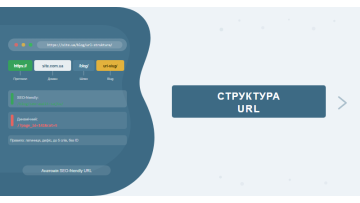
A URL (Uniform Resource Locator) is the unique address of every page on the web. It breaks down into: protocol (https://), domain (seo-factory.com.ua), path (/en/website-promotion/seo-site-audit/), and optionally query parameters (?page=2).
The slug is the portion of the path that identifies a specific page. In /blog/url-structure/, the slug is url-structure. That is exactly what Googlebot and the user see in the browser bar.
Why URL structure affects SEO:
- Crawlability: Googlebot reads the URL to infer site hierarchy and page priority. A descriptive slug speeds up and guides the crawl.
- Relevance signal: a keyword in the URL provides a weak but confirmed relevance signal — Google has acknowledged this officially.
- CTR: the URL appears below the title in search results. A readable address builds trust and can improve click-through rate by 3–8% (based on our observations across several e-commerce projects).
- Anchor text effect: when someone pastes a URL as a link, the slug becomes the anchor text.
/seo-audit/sends a stronger signal than/?id=4721.
In our audits, we consistently find sites with thousands of URLs like /?p=3145 or /cat/sub/sub2/sub3/sub4/product-name/. Both are problematic: the first carries zero semantic signal, the second wastes the crawl budget on low-priority paths.
Rules for building SEO-friendly URLs
Google outlines the baseline requirements in its official documentation. We have added practical observations from our own work — details are also covered in Google Search Central.
- Latin characters only. Cyrillic or other non-ASCII URLs are technically valid (browsers encode them as percent-encoded strings), but they display poorly in search results, get copied as garbled strings, and make weak anchors. Transliterate or use meaningful English words.
- Lowercase only.
/Seo-Audit/and/seo-audit/are technically different URLs on case-sensitive servers. Always generate lowercase slugs and redirect uppercase variants. - Hyphens as word separators. Google explicitly states that hyphens (
-) are word separators; underscores (_) are not./seo-audit/is parsed as two words;/seo_audit/is parsed as one. - Target keyword in the slug. The slug should describe the page, not be a string of characters.
/blog/url-structure-guide/outperforms/blog/post-2847/. - Short and to the point. Aim for 3–5 words per slug. Remove stop words: «and», «or», «for», «the», «a».
- Consistent trailing slash policy. Decide on a standard — with
/or without — and apply it everywhere. Set up a 301 redirect for the alternative format. - No special characters. Characters such as
? & = # % + , ; : @ $ ! ' ( ) *are either percent-encoded or reserved for query parameters. Keep them out of slugs. - Hierarchy mirrors site structure. The URL path should indicate where a page sits in the site architecture. A page under «Services → SEO → Audit» could live at
/services/seo/audit/.
Practical tip: before renaming URLs on a live site, compile a list of all existing addresses along with their inbound link counts (via Ahrefs or GSC). Pages with 10+ inbound links are the highest priority for a careful 301 redirect setup.
Clean URLs vs dynamic URLs
Clean URLs (also called human-readable or SEO-friendly URLs) look like /blog/url-structure/. Dynamic URLs carry query parameters: /?page=blog&id=142&lang=en. Both can be indexed by Google, but the difference in SEO value is significant.
| Factor | Clean URL | Dynamic (parametric) URL |
|---|---|---|
| Example | /blog/seo-audit/ |
/?p=2847&cat=blog |
| Keyword in URL | Yes | No |
| SERP CTR | Higher (topic is visible) | Lower |
| Anchor when copied | Meaningful | Meaningless |
| Crawl budget use | Efficient | Bot can generate endless variants |
| Duplicate risk | Low (if set up correctly) | High (parameter combinations) |
| Setup complexity | Requires mod_rewrite or routing | Generated by CMS out of the box |
| Google recommendation | Yes (official) | Acceptable with limitations |
In our experience migrating several e-commerce projects from dynamic to clean URLs, most sites saw a 15–25% increase in indexed pages within 4–6 weeks — provided all 301 redirects were implemented correctly. Googlebot also began crawling high-value pages more frequently.
URL depth: how many levels is optimal
URL depth is the number of levels in the path after the domain. For example:
- 1 level:
/services/ - 2 levels:
/services/seo/ - 3 levels:
/services/seo/technical-audit/ - 4 levels:
/services/seo/technical-audit/checklist/
Google sets no hard limit, but there are practical consequences:
- 1–3 levels: Googlebot crawls without any issues; the number of clicks from the homepage to the page is minimal, which helps PageRank flow.
- 4 levels: acceptable for large e-commerce stores with deep category trees.
- 5+ levels: signals to Google that the page is «far» from the homepage. Crawl budget is spent inefficiently, and important pages at this depth may be crawled less often.
From our audit experience: the most common cause of excessive URL depth is CMS auto-generation without structural planning. WordPress with hierarchical categories, combined with WooCommerce, can easily produce URLs with 5–6 levels by default.
The practical recommendation: no more than 3 levels for content sites and blogs; 4 levels are acceptable for e-commerce. If a page sits on the 5th level and is commercially important, consider rethinking the site architecture or flattening the structure.
Common URL structure mistakes
These are the issues we encounter in the vast majority of sites during a technical SEO audit. Some have been present for years, quietly draining crawl budget and link equity.
The full verification algorithm is described in our technical SEO audit guide.
1. Non-Latin characters in URLs
URLs containing Cyrillic or other non-ASCII characters are percent-encoded by the browser: /blog/структура/ becomes /%D0%B1%D0%BB%D0%BE%D0%B3/.... This appears in search results, looks unprofessional, and is handled inconsistently by analytics tools. The fix: transliterate or use English slugs.
2. Trailing slash duplicates
If /blog/ and /blog both return 200 OK without a redirect, Google sees two separate pages. Crawl budget is doubled and link equity is split. Set a single canonical format and redirect the other with a 301.
3. Session IDs and UTM parameters in indexed URLs
/?utm_source=email&utm_campaign=may can end up in the index if users share the link. Google usually identifies these, but not always. Block them in GSC's URL Parameters tool or use canonical tags.
4. Excessively long slugs
A 10–15-word slug is common on WordPress sites where the CMS auto-generates the slug directly from the H1 title. /blog/how-to-correctly-configure-url-structure-for-seo-in-google-search/ is hard to read and share. Aim for 3–5 words.
5. Mixed case
/Blog/Post-Title/ and /blog/post-title/ are different URLs on case-sensitive servers. Redirect all uppercase variants to lowercase and configure your CMS to generate lowercase slugs consistently.
6. Underscores instead of hyphens
/seo_audit_site/ is treated by Google as a single word rather than three separate terms. For already-indexed URLs with underscores, migrate them with 301 redirects.
7. Numeric IDs with no semantic value
/?product_id=4821 or /p4821 carry zero semantic signal. Even if the page is well-optimised in the title and meta tags, the URL adds nothing to relevance.
Quick check: run
site:yourdomain.com in Google and scan the results. If you see URLs with percent-encoding, raw parameters, or random numbers — schedule an audit.
URL strategy for e-commerce: categories, filters, pagination
Online stores face a unique challenge: filters and pagination generate hundreds or thousands of URL variants that can end up in the index and waste the crawl budget on low-value pages. This is one of the most frequent problems in e-commerce SEO.
Category structure
The standard setup:
- Category:
/sneakers/ - Subcategory:
/sneakers/mens/ - Product:
/sneakers/mens/nike-air-max-270/
An alternative for stores where products appear in multiple categories: a flat product URL like /products/nike-air-max-270/ with breadcrumb schema to communicate hierarchy.
Filter URLs
Two valid approaches:
- Canonical or noindex:
/sneakers/?color=black&size=42→ canonical pointing to/sneakers/. Correct for filters with no independent search demand. - Static landing URL:
/sneakers/black/— a standalone URL with its own optimisation. Correct when there is real search volume for «black sneakers».
Pagination
Pagination pages /blog/page/2/, /blog/page/3/ should remain in the index, but should not be treated as standalone landing pages. Avoid setting a canonical pointing to /blog/ — Google may then stop crawling deeper pages. The right approach: give each pagination page a unique title and meta description.
| URL Type | Recommended handling | Canonical | In index |
|---|---|---|---|
| Category | Optimise as a landing page | Self-referencing | Yes |
| Filter (no demand) | Canonical or noindex | Points to base category | No |
| Filter (with demand) | Static URL, optimise separately | Self-referencing | Yes |
| Pagination | Unique title, no over-optimisation | Self-referencing | Yes |
| UTM URLs | Canonical or GSC parameters | Points to clean URL | No |
| Session IDs | Block in robots.txt | — | No |
URL audit: tools and method
A regular URL audit is a core part of comprehensive SEO work. Here is the process we follow in practice.
Screaming Frog SEO Spider
- Run a full site crawl. Go to Configuration → Spider and confirm that all content types are enabled.
- Filter by URL length. In the URL tab, apply Filter → Over 115 characters. Any URL longer than 115 characters is a candidate for shortening.
- Find parametric URLs. Go to URL → Filter → Contains and type
?. Review the list and decide which parameter URLs should be closed. - Check for uppercase. Export all URLs and run a regex search for
[A-Z]in any text editor to catch mixed-case issues.
Google Search Console
- Pages indexing report: check which URLs Google has excluded and why. A high count of «Duplicate without canonical» is a clear sign of URL structure problems.
- URL Parameters settings (legacy GSC) or robots.txt Disallow rules — specify which query parameters Google should ignore when crawling.
- Indexed vs Crawled but not indexed: if commercially important pages are not indexed, check their URL depth and the number of internal links pointing to them.
Ahrefs Site Audit
- Run an audit and open Issues → URL Issues.
- Watch for: «URL contains uppercase letters», «URL too long», «URL contains underscores».
- Use Site Explorer → Best by Links to verify that pages with the most external links do not have poor URL structures.
For ongoing reference, we recommend checking Search Engine Land's URL structure guide, which is updated regularly with the latest Google best practices.
In Practice
A Kyiv-based travel agency offering European and Asian tours came to us after attempting their own URL migration. Around 1,600 tour pages had been living at addresses like /tour/?id=4821. The new clean URLs following the pattern /tours/europe/italy/rome-5days/ were technically in place.
A Screaming Frog crawl revealed that 340 of the configured redirects were redirect chains — two or three hops each: the old ID address to a temporary technical slug to the final clean URL. Google does not automatically collapse these chains, and each extra hop bleeds link equity before it reaches the destination page.
We rebuilt all 340 problem redirects by hand, mapping the original /?id= addresses directly to the final /tours/ URLs with clean 301s, then ran a GSC coverage check to catch any newly orphaned pages.
Seven weeks later, the agency recorded ranking improvements of 8–15 positions across 200+ geo-modified queries — terms like «tours to Rome from Kyiv» and «budget Bali excursions». Domain visibility in Ahrefs rose 41%. Pages with a three-level URL like /tours/asia/bali/ began ranking for regional clusters faster than expected; the hierarchical slug structure itself reinforced topical clustering without additional on-page changes.
Redirect chains after a URL migration are not a minor detail. On a travel site with 1,600 pages, every extra hop in the chain means that years of accumulated link equity arrive at the final URL in a weakened state. Running Screaming Frog in «All Redirects» mode is the first thing to do after any bulk URL change — before you start worrying about content or internal links.
Frequently asked questions
How many URL levels are safe for SEO without harming crawl budget?
The optimal depth is up to 3 levels: domain / category / page. More than 4 levels makes crawling harder and reduces PageRank flow. For large e-commerce sites, 4 levels is acceptable but should not be exceeded.
Does a trailing slash in a URL hurt rankings?
The trailing slash itself does not hurt, but duplicates do. If /page/ and /page both return a 200 OK instead of a 301 redirect, Google indexes them as two separate pages and splits the link equity between them.
How should filter URLs be handled in an online store?
Filter URLs with query parameters (?color=red&size=M) should be handled with noindex or a canonical pointing to the base category. Filters with genuine search demand (e.g. /sneakers/nike/) should be static URLs optimised individually.
Should I restructure URLs on an already-live website?
Yes, but only after a full audit. Every changed URL needs a 301 redirect from the old address. Mass renaming without redirects wipes out accumulated link equity and causes a traffic drop lasting 2–4 weeks.
Need a URL structure audit for your website?
We will check the hierarchy, duplicates, parameter bloat, and crawl depth — and deliver a clear remediation plan.