Your shopping cart is empty!
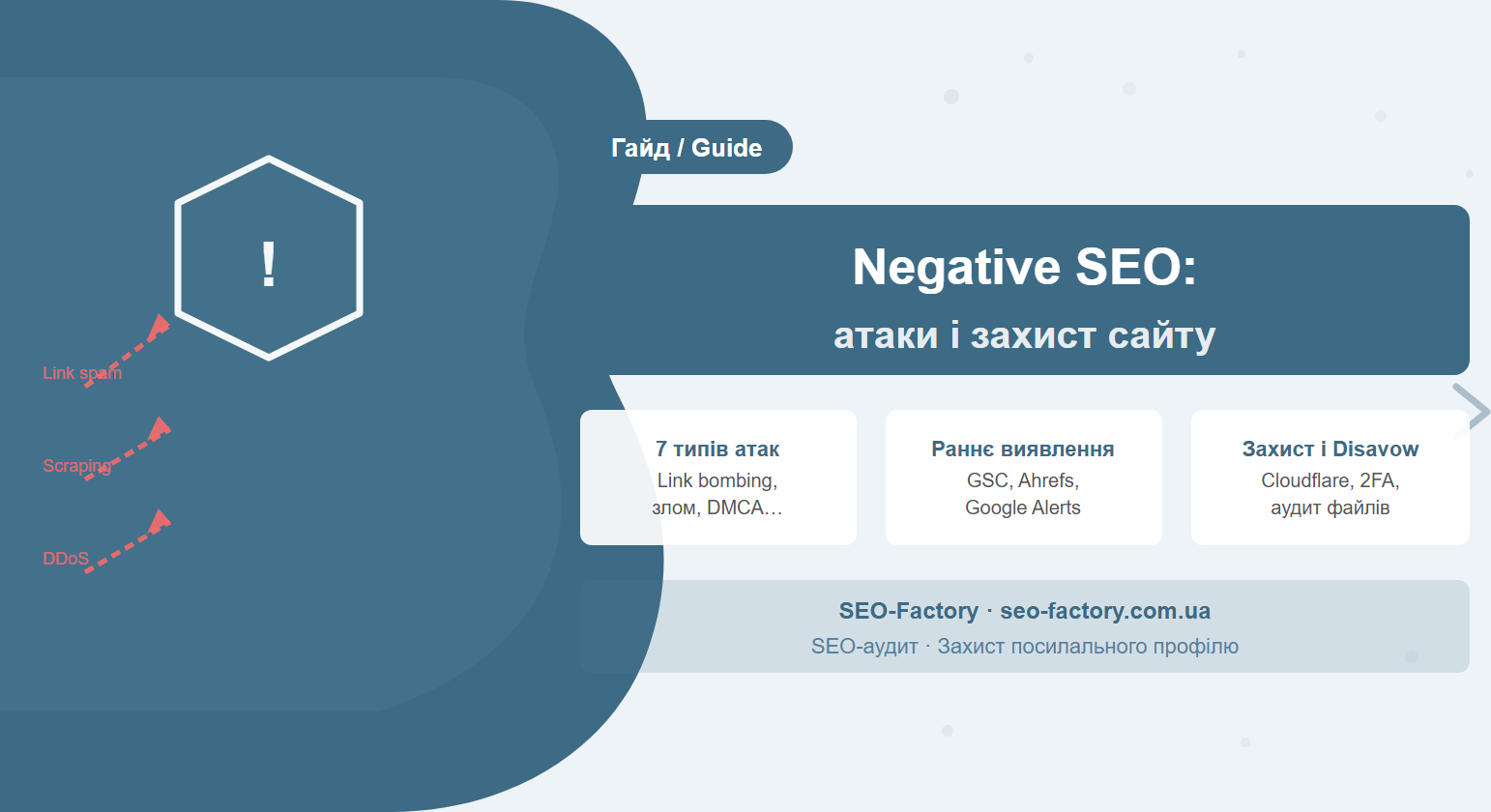
Negative SEO is the deliberate harm to your site's rankings through spam backlinks, content duplication, or hacking. Google ignores most attacks, but a sustained campaign in a competitive niche can genuinely work.
Contents
- What is Negative SEO and why it is not a myth
- Attack types: from backlinks to DMCA
- Risk matrix: which attacks are most dangerous
- How to detect an attack: tools and signals
- Response algorithm: what to do first
- Systematic protection against Negative SEO
- Monitoring: comparing methods
- Frequently asked questions
- Questions about Negative SEO
What is Negative SEO and why it is not a myth
At SEO-Factory, our first encounter with classic Negative SEO came in 2021: a client in the building materials niche lost 40% of organic traffic within two weeks. The culprit was mass backlink building — over 8,000 links from adult and gambling sites pointing to his homepage. Nobody would build that kind of profile voluntarily.
Negative SEO covers any deliberate action by a third party intended to lower your website's rankings or online reputation. Technically, this is not a new concept: search engines have battled manipulation since the earliest ranking algorithms appeared. But as competition grows and black-hat tools become cheaper, the threat has become more concrete.
Google officially acknowledges the problem and maintains the Disavow Tool precisely for these situations. In its spam policies, the company states that artificially built links are a violation regardless of who initiated them. Responsibility for the link profile lies with the site owner.
Does Negative SEO actually work? The answer is nuanced. The Penguin algorithm and continuous filter improvements have made Google more resistant to manipulation. But in high-budget, highly competitive niches — legal services, real estate, finance, gambling — attacks genuinely cause ranking drops and traffic loss.
It is also worth noting that Negative SEO is not always a competitor attack. There are cases of accidental spam — crossfire from third-party SEO campaigns — or the delayed consequences of past black-hat activity by the site itself finally catching up. But malicious intent is far more common than most admit.
Attack types: from backlinks to DMCA
Each Negative SEO attack targets a specific link in the ranking algorithm. Understanding the mechanics makes it easier to spot the threat early.
Link bombing (mass spam backlinks)
The most common method. The attacker builds thousands of links from low-quality or topically irrelevant sources — PBN networks, forums, adult and gambling sites, directories. The goal is to "poison" your link profile so Google associates the domain with manipulation.
Practical signal: if the number of new backlinks in GSC jumps 3–5× within 1–2 weeks without an obvious reason (viral content, PR campaign) — check the quality of those new links immediately.
Scraping and content duplication
Your site's content is automatically copied to hundreds of other resources. Google may treat the duplicates as the original, especially if they appear earlier or have stronger domain authority. A real case: a client in the online education niche found 230+ copies of their articles via Google Alerts within a single month.
Fake branded content
Attackers publish negative reviews, fake "exposés," or compromising content featuring your brand name. The goal is to damage branded search queries and undermine E-E-A-T signals. More on why trust signals matter in our article on E-E-A-T and how Google evaluates trust.
Fake reviews
Mass negative reviews on Google Business Profile, Trustpilot, or industry platforms. They do not directly affect organic rankings, but they lower CTR in local search results and erode user trust.
Site hacking: hidden links and redirects
The most dangerous scenario. The attacker gains access to your site's files or database and injects hidden links to spam resources, or configures redirects triggered only for search engine bots. Google detects this — and the site receives a manual penalty.
DDoS attacks
A mass server attack makes the site unavailable or significantly slows response time. This directly degrades Core Web Vitals — primarily TTFB and LCP — and can negatively affect rankings if sustained long enough.
False DMCA complaints
A competitor files a copyright infringement claim with Google, asserting that your original content copies their material. Google may delist pages from search results while investigating.
| Attack type | Risk to rankings | Speed of impact | Detection method |
|---|---|---|---|
| Link bombing | Medium–High | 2–8 weeks | GSC → Links, Ahrefs Alerts |
| Content scraping | Medium | 1–4 weeks | Google Alerts, Copyscape |
| Hacking + hidden links | Critical | Days | File audit, GSC Manual Actions |
| DDoS | Medium | During attack | Uptime monitoring, Core Web Vitals |
| Fake reviews | Low (CTR) | 1–3 weeks | Google Business Profile, Trustpilot |
| Fake branded content | Medium | 2–6 weeks | Google Alerts, branded queries |
| False DMCA | High (targeted) | 1–7 days | Google Search Console notifications |
Risk matrix: which attacks are most dangerous
Not all attacks pose equal threats to rankings. We evaluate them on two axes: the likelihood of successfully impacting rankings, and the difficulty of detection and neutralisation.
Site hacking with injected hidden links or redirects stands apart: it is not merely an SEO attack but a security breach that can trigger a manual Google penalty and cause traffic to collapse within days. In our experience, clients who failed to detect a hack in time spent 3 to 6 months restoring rankings after cleanup and an approved reconsideration request.
How to detect an attack: tools and signals
Early diagnosis is the key to minimising losses. There is a concrete set of tools and signals that allow you to catch an attack before Google reacts with a ranking drop.
Google Search Console: the first line of defence
The Links section → External Links shows your current backlink profile. Compare it weekly: if the count of new links has risen unusually — open the list and inspect the domains. Look for:
- A sharp spike in the number of referring domains over a short period
- Links from obviously irrelevant niches (casinos, adult content, pharmaceuticals)
- Domains with no real content or clearly machine-generated text
- The same anchor text repeated identically across hundreds of different domains
Also check the Manual Actions section — if an attack has already landed, a notification from Google will appear here.
Ahrefs and Semrush: deeper analysis
Ahrefs Alerts lets you configure daily or weekly notifications for new backlinks. All new links arrive by email — you see the problem before Google has a chance to react. Semrush Backlink Audit automatically calculates a Toxicity Score for every link and groups them by risk level, making prioritisation fast.
Our approach: at SEO-Factory we run a monthly backlink profile audit for clients in competitive niches. Even without an active attack, this catches accumulating natural spam and lets us submit a Disavow file proactively. For a deeper look at building a healthy link profile, see our guide on link building and backlink profiles.
Google Alerts and Copyscape: content attacks
Set up Google Alerts for your brand name, domain name, and several unique phrases from your key pages. Any new occurrence of those phrases online is a reason to check for scraping. Copyscape lets you scan a specific URL and find all duplicates across the web.
Uptime and Core Web Vitals monitoring
Services like UptimeRobot, Pingdom, or Cloudflare's built-in monitoring log every instance of downtime. If your site was unreachable for hours during peak traffic — that has already affected Googlebot crawling and potentially Core Web Vitals. Regular technical SEO audits catch degradation in performance metrics before they compound.
Response algorithm: what to do first
Panic is the worst adviser when suspicious activity is discovered. Here is the step-by-step sequence we have refined across real client cases.
Step 1. Confirm the attack
Not every backlink spike is an attack. Check first: was there a recent PR campaign, media publication, or viral piece of content? Download the list of new links from GSC or Ahrefs and assess quality: if 80%+ of links come from domains with no real content or obvious spam — that is an attack.
Step 2. Preserve evidence
Take screenshots and export a CSV of suspicious links. This data will be needed when building the Disavow file and, as a last resort, when contacting Google through Search Console.
Step 3. Attempt manual removal
Disavow is not the first step. Google recommends trying to contact webmasters and requesting link removal first. In practice, this rarely works during an attack (no contact information, no responses), but documenting the attempts matters.
Step 4. Build and submit a Disavow file
The Disavow file is a plain .txt document where each line is a link URL or domain to reject (domain:example.com). It is submitted via Google Search Console → Disavow Links Tool. Google processes the file at the next link profile update — typically within 2–6 weeks.
Important: do not disavow good links. Disavow is a surgical instrument. Rejecting quality backlinks does more harm than spam links Google would have ignored anyway.
Step 5. If a hack is detected — immediate response
If foreign code or unauthorised file modifications are found: restore the site from a clean backup, change all passwords (admin, FTP, database), notify the hosting provider, scan the server for shells and backdoor scripts, then submit a reconsideration request in GSC after cleanup is complete.
Systematic protection against Negative SEO
Protection against Negative SEO is not a one-time measure but a set of ongoing practices. Here is what we actually implement for clients.
Links: prevention is better than recovery
Regular backlink profile audits — at minimum monthly in competitive niches. Configure Ahrefs or Semrush Alerts for new backlinks. Keep the Disavow file current: even without attacks, natural spam accumulates and it is better to reject it proactively.
Content: scraping protection
Configure Cloudflare or a similar WAF (Web Application Firewall) with rate limiting on requests per IP. This significantly complicates automated scraping. Additionally, set up Google Alerts for 5–7 unique phrases from each key page.
Technical site security
Two-factor authentication on all admin accounts (CMS, hosting, domain registrar). Regular updates of the CMS, themes, and plugins — most hacks exploit known vulnerabilities in outdated versions. Weekly backups to an external server or cloud storage.
Security checklist: check right now — do you have 2FA on all critical accounts? Is your CMS updated to the latest version? Is there a current site backup? If the answer is "no" to even one item — that is a vulnerability.
DDoS protection
Cloudflare's free plan provides basic DDoS protection. For serious resources — paid Cloudflare plans or specialised services (Sucuri, Imperva). Set up alerts for sudden traffic spikes or increased server response time.
Brand reputation
Monitor Google Business Profile: check reviews regularly and respond promptly to suspicious ones. Google gives business profile owners tools to flag and remove fake reviews. Track branded queries in GSC: a sudden drop in CTR on brand traffic is a signal of negative PR.
| Protection area | Minimum setup | Extended protection | Frequency |
|---|---|---|---|
| Backlinks | GSC → Links | Ahrefs Alerts + Semrush Audit | Weekly |
| Content | Google Alerts (brand) | Copyscape + rate limiting | Daily (Alerts) |
| Site security | CMS updates + backup | Wordfence/Sucuri + 2FA | Weekly |
| Uptime / Core Web Vitals | UptimeRobot | Cloudflare + PageSpeed monitoring | Continuous |
| Reputation | Google Business check | Brand24 / Mention | Weekly |
Monitoring: comparing methods
Not every business can afford the full stack of paid tools. Here is a comparison of approaches based on budget and risk level.
For small businesses in non-critical niches, a free toolkit is sufficient: Google Search Console for backlink monitoring, Google Alerts for mention tracking, and Cloudflare's free plan for basic DDoS protection and rate limiting.
For mid-size businesses or competitive niches — Ahrefs or Semrush for deep backlink analysis with weekly reports, Copyscape for regular checks of key pages, and a paid Cloudflare plan or Sucuri with WAF.
For large resources in highly competitive niches — the full stack of Ahrefs + Semrush, Brand24 or Mention for reputation monitoring, Imperva or specialised DDoS protection, plus regular external security audits.
In our work with clients, a properly configured alert system with a clear response process consistently outperforms the most expensive tool left unmonitored. A client who receives Ahrefs alerts and knows exactly what to do next is better protected than one paying for Semrush but never checking the reports.
It is worth highlighting the SEO site audit as regular preventive care. A technical audit covers not just on-page factors but also the link profile, security, and structural integrity — essentially a comprehensive check for signs of Negative SEO attacks.
Frequently asked questions
Can Negative SEO completely destroy a site's rankings?
Complete destruction is a rare scenario for authoritative domains with long histories. Google has long learned to ignore obvious spam. But a sharp drop of 20–50% in a competitive niche over a few weeks of sustained attack is entirely real and well-documented. The greatest risk falls on young domains (under 2 years old) and sites with a small number of quality incoming links.
How long does recovery take after an attack?
It depends on the attack type and speed of response. For link bombing with a timely Disavow submission — 4–12 weeks after the next algorithm update. For a hacked site with a manual penalty — 2 to 6 months after cleanup and an approved reconsideration request. Attacks caught before Google reacts with a ranking drop recover fastest of all.
Must you use the Disavow Tool when spam backlinks are found?
Not always. Google filters most obvious spam on its own. Disavow is appropriate when: you have received a manual penalty for unnatural links; there are clear signs of a mass attack (thousands of new links in days); the profile was already damaged by previous owners and a ranking drop is observed. Without clear signals, use the tool with caution.
How do you distinguish Negative SEO from a natural ranking drop?
Negative SEO typically comes with a clear correlation: a sudden backlink spike → a ranking drop 2–4 weeks later. Natural drops are usually gradual, with no anomalies in the link profile. Also check GSC for manual action or security notifications. If none of those are present — look for causes in algorithm updates or your own recent site changes.
Questions about Negative SEO
What will SEO-Factory do if I suspect a Negative SEO attack on my site?
SEO-Factory will conduct a site audit focused on the backlink profile: we will download the full link list, evaluate each link for toxicity, determine whether an attack is underway, build a Disavow file, and submit it through GSC. If needed, we will also check file integrity and site code for signs of hacking.
Does crowd marketing help defend against Negative SEO?
Crowd marketing from SEO-Factory places organic brand mentions on relevant platforms and forums. This strengthens brand signals and E-E-A-T, making the site more resistant to reputation attacks — fake reviews and counterfeit branded content. It does not directly affect the backlink profile, but it raises overall domain authority.
How often does SEO-Factory recommend auditing the backlink profile?
For sites in highly competitive niches (legal services, finance, healthcare, real estate) — monthly. For others — quarterly at minimum. As part of every regular SEO audit, we always check the backlink profile as a required block, even when the client has no suspicion of an attack.
Suspect a Negative SEO attack?
SEO-Factory will audit your backlink profile, identify toxic links, and prepare a Disavow file to protect your rankings.