Your shopping cart is empty!
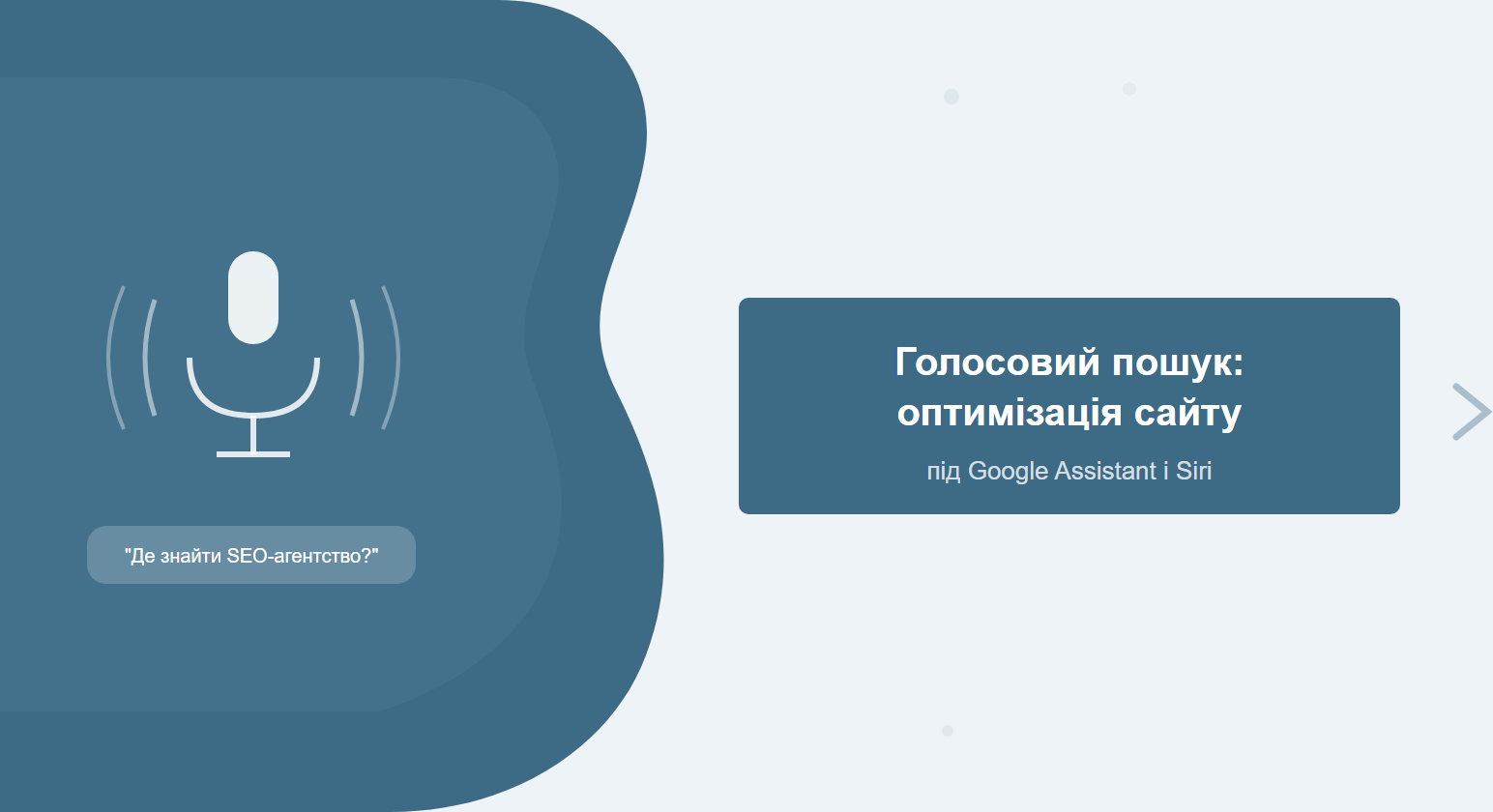
Voice search is no longer a "future technology": 27% of all mobile queries are now entered by voice. Google Assistant, Siri and Alexa read out a single result — the one that landed in the Featured Snippet. Here is a practical guide to making that result yours.
Contents
- Voice vs text queries: key differences
- Featured Snippet and voice search
- Question-based keywords and conversational content
- Site speed: why TTFB decides
- Schema markup for Voice Search
- Local voice search
- Mobile optimization
- Voice Search optimization checklist
- Frequently asked questions
Voice vs text queries: key differences
Someone types "laptop Kyiv buy" into a search bar, but asks aloud "where can I buy a laptop in Kyiv with same-day delivery". The difference is fundamental. Voice queries are:
- longer — 5–7 words instead of 2–3;
- question-based — starting with "how", "where", "what", "when", "why", "who";
- conversational — natural language without abbreviations;
- often local — "near me", "in my city", "closest";
- action-oriented — "call", "get directions", "open now".
This difference means the keyword strategy for voice search is built differently. Instead of short transactional terms, you need long question-based phrases — conversational keywords.
| Parameter | Text search | Voice search |
|---|---|---|
| Average length | 2–3 words | 5–7 words |
| Query form | Keywords, fragments | Full sentences, questions |
| Intent | Informational / transactional | Local / action-driven |
| Device | Desktop / mobile | Smartphone / smart speaker |
| User-facing result | List of links | One spoken answer |
| Key SEO factor | Top-10 ranking | Position 0 (Featured Snippet) |
Featured Snippet and voice search
According to a Backlinko study, 40–50% of Google voice search answers are pulled from the Featured Snippet. This is the "zero position" — a block with a direct answer above the standard results.
To appear in the Featured Snippet, content must answer a specific question clearly and concisely. For a deeper dive into the zero-position strategy, see our guide to Featured Snippets: how to win Position 0.
The 40–50-word rule: the answer in the first paragraph after a question-based H2/H3 should contain 40–50 words. That is the volume Google most often extracts into the Featured Snippet and reads out through voice assistants.
Question-based keywords and conversational content
The first step is collecting question-based queries to write content around. Three main tools:
- Answer The Public — generates hundreds of questions for your topic: who, what, where, how, when, why.
- AlsoAsked — shows hierarchical question clusters from the People Also Ask block.
- People Also Ask in Google — expand several PAA levels for your main keyword and note the questions.
Once you have the questions, structure content as "question — short answer — details":
- H2 or H3 — the exact question (or as close as possible).
- First sentence after the heading — a direct answer in 1–2 sentences.
- Rest of the paragraph — details, examples, links.
Avoid bureaucratic language and complex constructions. Voice assistants read text aloud, so sentences must sound natural. More on keyword strategy — in our article on semantic keyword core: collection and clustering.
Site speed: why TTFB decides
A Backlinko study found: the average TTFB of sites in voice search results is 54 ms, while the average website responds in 380 ms. That is a fivefold difference.
Why does speed matter so much specifically for Voice Search? A voice query expects an instant answer. If Google sees a page loading slowly, it selects another candidate for the Featured Snippet.
Practical steps to speed up
- TTFB < 200 ms — check via GTmetrix or PageSpeed Insights. If higher, the problem is hosting or server-side caching.
- Compress images — WebP instead of JPEG/PNG, lazy loading for below-fold images.
- Minify CSS and JS — combine files, remove unused code.
- CDN — serving static assets from geographically close servers cuts response time by 30–60%.
- HTTP/2 or HTTP/3 — parallel resource loading without queuing.
Check Core Web Vitals in Google Search Console → Experience → Core Web Vitals. LCP below 2.5 s and CLS below 0.1 are the minimum bar for competing in voice search.
Full speed checklist — in our article on Core Web Vitals: LCP, INP and CLS.
Schema markup for Voice Search
Structured data helps Google understand which part of a page answers a specific question. Three Schema types are priority for voice search:
1. FAQPage Schema
The most important for Voice Search. Add JSON-LD with a block of questions and answers at the end of the page. Each answer — 40–60 words, no HTML tags, clear and to the point. Google extracts these answers to read out through assistants.
2. HowTo Schema
For step-by-step instructions. Queries like "how to do X" are voice search classics. Each step is a separate HowToStep object with a name and text.
3. LocalBusiness Schema
For queries like "where is", "open now", "phone number". Add name, address, phone, opening hours and geo-coordinates. NAP signals (Name, Address, Phone) must match Google Business Profile exactly.
Local voice search
Queries like "café near me", "closest car wash", "pharmacy open now" account for 22% of all voice queries according to Google. What they share: the user wants a solution here and now.
What drives results in local Voice Search
- Google Business Profile — fully completed profile with current opening hours, photos and replies to reviews. More in our guide to local SEO and Google Business Profile.
- NAP consistency — name, address and phone identical on the site, in GBP and in all directories.
- LocalBusiness Schema — add geo-coordinates, addressRegion, openingHours.
- Local keywords — "in London", "near Victoria station", "open on Sundays".
- Reviews with rating ≥ 4.0 — Google favours well-rated businesses when selecting a voice answer.
"Where to buy flowers in London with same-day delivery?" — the winner is whoever has a complete GBP, current reviews and LocalBusiness Schema with the deliveryAvailable parameter.
Mobile optimization
Over 90% of voice queries happen on mobile devices. Google has long moved to Mobile-First Indexing — ranking sites by their mobile version. If the mobile version is weaker than desktop, you lose in voice search.
Mobile checklist for Voice Search
- Pass Google's Mobile-Friendly Test — zero blocking errors.
- Buttons and links at least 48×48 px — fingers are bigger than cursors.
- Font minimum 16 px — no horizontal scrolling.
- Viewport meta tag set correctly.
- No content available only on desktop.
- CLS < 0.1 — page does not "jump" during loading.
Full guide — in the article on Mobile-First Indexing: readiness checklist.
Voice Search optimization checklist
| Area | Task | Priority |
|---|---|---|
| Content | Collect question-based queries via Answer The Public, AlsoAsked | High |
| Content | Add FAQ section with 40–60-word answers | High |
| Content | Rewrite intros using the "answer first — details second" principle | Medium |
| Technical | Measure TTFB, bring it under 200 ms | High |
| Technical | Review Core Web Vitals in GSC | High |
| Schema | Add FAQPage Schema to pages with FAQ | High |
| Schema | Set up HowTo Schema for instructional content | Medium |
| Local | Update Google Business Profile (photos, hours, replies) | High |
| Local | Verify NAP consistency across directories | Medium |
| Mobile | Pass Mobile-Friendly Test | High |
| Mobile | Fix CLS and layout shifts | Medium |
Frequently asked questions
- How is voice search different from regular search for SEO?
- Voice queries are twice as long on average, almost always question-based and use conversational language. Google selects answers primarily from Featured Snippets — so a page at Position 0 becomes the voice answer. Standard top-10 ranking does not guarantee Voice Search visibility.
- What site speed is needed for voice search?
- According to Backlinko research, the average TTFB of pages in voice search is 54 ms. In practice, target TTFB under 200 ms and total load time under 2 seconds — achievable even on standard hosting with correct caching.
- Which Schema markup matters most for Voice Search?
- Three priority types: FAQPage (for question-based queries), LocalBusiness (for "where" and "near me" queries), HowTo (for step-by-step instructions). FAQPage is the most versatile — it suits virtually any content with clear, direct answers.
- How do I know if my niche has voice search traffic?
- Open Google Search Console and filter queries starting with "how", "where", "what is", "when". A high share of such queries signals voice traffic. Also expand 3–4 levels of People Also Ask in Google for your main keywords and study the questions.
Should I optimize for Siri and Alexa separately from Google Assistant?
Generally no — all three assistants use Google Search results as their primary source for web queries. Optimizing for Google Featured Snippet and FAQPage Schema automatically improves visibility across all three. Alexa partially uses Bing, but for most markets Google dominates.
Does long-form content help for voice search?
Length alone is not a factor. What matters is answer clarity: pages in voice search average a 9th-grade readability score (Flesch-Kincaid scale). Simple sentences and direct answers outperform complex academic prose. Long content is useful when it covers many questions — each with its own H2 and a clear, concise answer.
What tools can I use to analyze voice search traffic?
There are no dedicated tools for tracking voice traffic exclusively — Google does not provide that breakdown. Look for indirect signals: growth of long question-based queries in GSC, increased mobile traffic on FAQ pages, appearing in Featured Snippets for question-based keywords. Answer The Public and AlsoAsked are the go-to tools for semantic research.
Want Google Assistant and Siri to recommend your site?
SEO-Factory optimizes content for question-based queries, configures FAQ Schema and improves load speed for voice search.