Your shopping cart is empty!
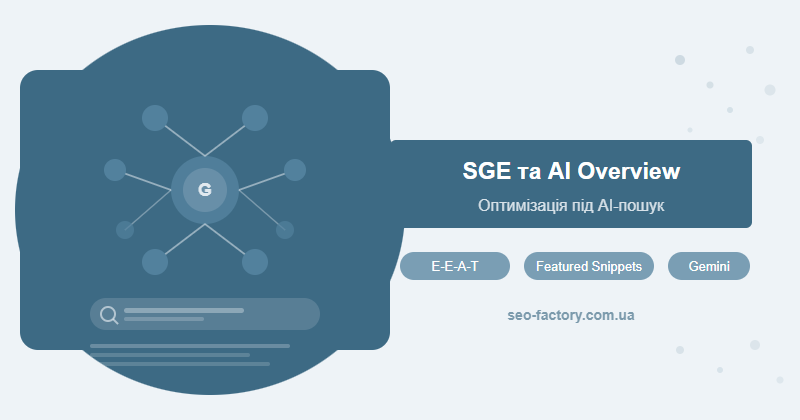
Google's AI Overview synthesizes answers from dozens of websites and surfaces them above organic results. Staying visible — and getting cited as a source — requires a deliberate strategy: structured answers, strong E-E-A-T signals, and content architecture built for how Gemini reads the web.
Contents
- What Is SGE and AI Overview
- How AI Overview Selects Sources
- AI Overview vs Featured Snippets
- How SERP Changed in 2024–2025
- E-E-A-T and Source Authority
- Optimizing Content for AI Search
- Technical Signals for AI Overview
- Monitoring AI Overview Visibility
- Frequently Asked Questions
What Is SGE and AI Overview
SGE — Search Generative Experience — was the name of Google's experimental AI-powered search project, launched in May 2023 through Search Labs. The core idea was straightforward: instead of presenting a list of links and leaving users to find answers themselves, the search engine generates a ready-made synthesized response directly on the results page.
At Google I/O in May 2024, SGE was officially rebranded as AI Overview and began rolling out broadly for English-language queries in the United States. By the end of 2024, AI Overview had expanded to more than 100 countries and dozens of languages, fundamentally altering how Google presents search results for informational queries.
Technically, AI Overview is a block at the top of the SERP that:
- is generated by Google's Gemini large language model;
- synthesizes information from multiple sources simultaneously;
- displays links to contributing websites (typically 5–15 sources);
- includes a "Show more" button for expanded detail;
- updates dynamically based on the specific query.
One key distinction to internalize: AI Overview is not a separate search index. It is a layer built on top of Google's standard organic index, using already-indexed content as raw material for response generation. A site that does not rank in the top 20 for a query has almost no chance of appearing as an AI Overview source for that same query.
From our practice: clients whose sites already held positions 1–5 in organic search began appearing as AI Overview sources without any additional action — purely on the strength of their existing authority and content structure. Strong organic SEO is still the entry ticket.
How AI Overview Selects Sources
Google has not published a detailed technical specification for AI Overview source selection. But analysis of thousands of SERPs and research published by the SEO community reveals a consistent set of contributing factors.
Organic ranking position
The first and most decisive filter is traditional SEO ranking. Research covered by Search Engine Land showed that over 80% of AI Overview sources rank in the top 10 organic results for the corresponding query. If your site does not rank organically, the odds of appearing in AI Overview are negligible.
Answer quality and content structure
Gemini prioritizes pages that give a clear, direct answer to the query. Signals of citation-worthy content include:
- Opening paragraph delivers a specific answer (answer-first approach);
- H2/H3 headings that address derivative questions within the topic;
- structured lists rather than dense prose blocks;
- specific numbers, dates, and verifiable facts — not vague claims;
- a FAQ section with naturally-phrased questions.
Authority and trust signals
Google applies E-E-A-T assessment when selecting AI Overview sources. Trust signals include:
- a strong, natural backlink profile from relevant industry sources;
- an "About" page with real authors and verifiable credentials;
- brand mentions across the web (both linked and unlinked);
- content freshness — recently updated pages have a measurable advantage;
- alignment between the author's demonstrated expertise and the topic covered.
Topical authority
AI Overview consistently favors sites that cover a subject deeply and systematically, not just broadly. A healthcare clinic's blog with 50 detailed articles on symptoms, treatments, and prevention will outperform a general news site with a single article on the same medical topic — even if the news article ranks similarly.
Gemini does not simply paraphrase the first organic result. It synthesizes fragments from multiple sources, selecting the passages that most accurately address each specific aspect of the query.
AI Overview vs Featured Snippets
Before AI Overview arrived, the Featured Snippet was the primary mechanism for capturing "position zero." Today these two elements coexist on the SERP — but they work very differently, and the optimization implications are distinct.
| Attribute | Featured Snippet | AI Overview |
|---|---|---|
| Source | Single website | 5–15 websites simultaneously |
| Answer generation | Extracts an existing text fragment | Generates a new answer from sources |
| Query types | Mainly "how to", definitions | Complex, multi-faceted queries |
| CTR impact | Can raise or lower CTR | Often lowers CTR for top positions |
| Direct control | Can be optimized directly | Indirect influence via SEO signals |
| SERP frequency | Roughly 8% of all queries | 10–40% depending on market and query type |
An important practical note: Featured Snippets and AI Overview are not mutually exclusive. A single query can trigger an AI Overview at the top and a Featured Snippet below it. Optimizing for Featured Snippets remains a relevant tactic, as covered in our guide to winning Featured Snippets and position zero.
Field observation: sites that already held Featured Snippets for a query before AI Overview launched consistently became source citations for those same queries once AI Overview appeared. The content patterns that win Featured Snippets — direct answers, structured formatting — transfer directly to AI Overview optimization.
How SERP Changed in 2024–2025
The rollout of AI Overview reshaped the Google results page in ways that demand a revised approach to organic traffic strategy. Here are the most significant shifts.
Organic results pushed down the page
When AI Overview appears, the first organic result moves lower. On mobile devices, it can drop below the fold entirely. This directly depresses CTR for positions 1–3 on queries where AI Overview is present.
Data from multiple large-scale studies conducted in 2024–2025 showed:
- CTR declines of 15–45% for informational queries with an AI Overview;
- near-zero impact on transactional and local intent queries;
- impressions rising while clicks fell — a classic "zero-click" pattern;
- sites cited as AI Overview sources gaining additional clicks through the inline links.
Expanded query types now triggering AI Overview
Early AI Overview appeared mainly on simple informational queries. By 2025, it had spread to:
- complex comparison queries ("which is better — X or Y");
- quantitative queries ("how much does X cost");
- navigational queries involving widely-used terms;
- current events and news-adjacent queries.
New SERP features introduced alongside AI Overview
Google introduced several related changes to the results page in the same period:
- AI-organized results — the SERP is divided into thematic sections;
- Perspectives — a block featuring opinions from forums and social media;
- Discussions and forums — Reddit, Quora, and equivalents rose sharply in rankings;
- Web filter — lets users switch to classic organic results only.
Who felt the impact most
The SERP changes did not affect all site types equally. The categories experiencing the most significant disruption:
- Informational publishers (wikis, glossaries, reference databases) — steepest traffic losses;
- News sites — mixed results, with some recovery through Perspectives visibility;
- Commercial and e-commerce sites — minimal impact, as AI Overview rarely appears for transactional queries.
E-E-A-T and Source Authority
E-E-A-T stands for Experience, Expertise, Authoritativeness, and Trustworthiness — the framework Google uses to evaluate content quality. It was already important before AI Overview; it has become foundational now.
Why E-E-A-T drives AI Overview selection
AI Overview does not simply pull any relevant content — it favors sources Google already trusts. And Google's trust framework is built on E-E-A-T signals. Sites with weak E-E-A-T rarely appear as AI Overview sources even when they rank organically, because Gemini applies an additional quality filter beyond raw position.
Experience signals
The first "E" in E-E-A-T is experience — evidence that the author has firsthand involvement with the topic:
- specific case studies from real projects ("we implemented X and saw Y result");
- photographs or video documentation of the process or outcome;
- precise dates, figures, and named companies in examples;
- honest acknowledgment of limitations ("this approach failed in situation Z").
Expertise signals
Demonstrated, verifiable competence in the subject:
- author pages with credentials (education, certifications, publications);
- citations of peer-reviewed research or official documentation;
- genuine depth of coverage — nuance, edge cases, not just surface-level summaries;
- accurate, contextually appropriate use of technical terminology.
Authoritativeness signals
External recognition of your site as a credible source within the field:
- backlinks from recognized industry authorities;
- unlinked brand mentions across trusted publications;
- bylines or coverage in mainstream media;
- inbound links from .gov or .edu domains.
Trustworthiness signals
Technical and operational indicators that the site is safe and reliable:
- HTTPS with a current, valid SSL certificate;
- clear privacy policy and terms of service;
- verifiable contact information and physical address (critical for YMYL niches);
- positive independent reviews and ratings;
- clean history — no manual actions or algorithmic penalties.
In our client work, sites with well-developed author profiles and documented real-world case studies are cited in AI Overview roughly twice as often as comparable sites without these elements. Full deep-dive available in our guide to E-E-A-T and how Google evaluates expertise and trust.
Optimizing Content for AI Search
Optimizing for AI Overview is not a separate discipline — it is an intensification of best-practice SEO. The following techniques have the strongest demonstrated impact on citation frequency.
Answer-first content structure
The single most important principle: deliver the answer to the primary question within the first 2–3 sentences. Gemini prioritizes the opening of a page when scanning for citable content.
Content template: Question → direct answer (1–2 sentences) → expanded explanation → supporting details and edge cases. Never open with scene-setting preamble that delays the actual answer.
FAQ sections with FAQPage schema
FAQ blocks are among the most reliable paths into AI Overview. Gemini frequently pulls sub-question answers directly from FAQ sections. Each Q&A pair should:
- be phrased in natural language, mirroring how people actually search;
- deliver a concrete answer in 2–5 sentences;
- be marked up with FAQPage JSON-LD schema;
- address long-tail query variations around the core topic.
Format matching query intent
Different question types call for different response formats — and AI Overview mirrors this:
- Definitions ("what is X") — direct definition in the first sentence, then elaboration;
- Comparisons ("X vs Y") — comparison table with clear, labeled criteria;
- Processes ("how to do X") — numbered step list with HowTo schema markup;
- Recommendations ("best X") — specific examples with explicit selection criteria;
- Quantities ("how much does X cost") — the number first, then context and range.
Topical cluster coverage
A single article will rarely be cited across all aspects of a broad topic. A site with a content cluster — a pillar page plus multiple supporting articles — consistently outperforms a site with one all-encompassing post. The cluster model works because:
- the pillar page establishes broad topical authority;
- supporting articles address specific sub-queries in depth;
- internal links between cluster pages signal thematic coherence to Google.
Our detailed guide on building a keyword semantic core and content clusters walks through the full methodology.
Content freshness and regular updates
Gemini favors current information. Pages with recent update dates and up-to-date data outperform stale content. Recommended practice:
- review and update key articles every 6–12 months;
- add new data, recent research, and current examples;
- only update the publication date when substantive changes are made — not cosmetic edits;
- add a visible "Last updated:" timestamp for transparency with both users and crawlers.
Technical Signals for AI Overview
Technical SEO remains the foundation. Content optimization delivers its full potential only when the technical infrastructure is solid. Here are the technical factors most relevant to AI Overview visibility.
Core Web Vitals and page speed
Google has confirmed Core Web Vitals as a ranking signal. Since AI Overview pulls sources from the top-10 organic results, and pages with poor Core Web Vitals rank lower — the relationship is direct. Target benchmarks:
- LCP (Largest Contentful Paint) — under 2.5 seconds;
- INP (Interaction to Next Paint) — under 200 ms;
- CLS (Cumulative Layout Shift) — below 0.1.
See our full technical breakdown in the guide to Core Web Vitals: LCP, INP, and CLS.
Schema.org structured data
Schema markup helps Gemini understand your page's structure and content type at a deeper level. The schema types with the strongest demonstrated impact on AI Overview:
- FAQPage — Q&A pairs are directly cited in AI Overview responses;
- HowTo — structured steps for process-oriented queries;
- Article — confirms content type and authorship;
- Organization / Person — E-E-A-T signals for publisher and author;
- BreadcrumbList — communicates site hierarchy to the crawler.
Mobile optimization
AI Overview is particularly active in mobile SERPs. With mobile-first indexing, the mobile version of your site is the definitive version Google evaluates. Non-negotiable requirements:
- responsive design that renders correctly across all screen sizes;
- body text at 16px or larger;
- tap targets (buttons, links) with a minimum size of 44×44px;
- no horizontal scrolling on any viewport width.
Crawlability and indexation
This sounds basic, but it is frequently the issue: Googlebot must be able to crawl and index your pages without obstruction. Checklist:
- no blocking rules in robots.txt for important content pages;
- canonical tags configured correctly with no circular or conflicting signals;
- JavaScript-rendered content is accessible to Googlebot — test in GSC's URL Inspection tool;
- page speed issues are not caused by render-blocking scripts.
The full audit methodology is covered in our technical SEO audit step-by-step guide.
Monitoring AI Overview Visibility
Tracking AI Overview presence is a relatively new capability. Until late 2024, most standard SEO platforms lacked this feature. The toolset has matured quickly since then.
Semrush AI Overview Tracking
Semrush integrated AI Overview tracking into its Position Tracking module. Key capabilities:
- detection of AI Overview presence per keyword;
- identification of whether your site is cited as a source;
- competitive comparison of AI Overview share of voice;
- historical trend data over time.
SE Ranking
SE Ranking's rank tracker also monitors AI Overview appearances. Particularly useful for URL-level analysis and side-by-side comparison with Featured Snippet data.
BrightEdge
The enterprise-grade BrightEdge platform offers granular AI Overview analytics: trigger frequency, share of voice in AI Overview, and topic-level trend analysis. Best suited for large sites tracking thousands of queries.
Google Search Console
Since June 2026, GSC includes a dedicated AI Overview report in the Performance section. But indirect signals are worth monitoring:
- a sharp CTR drop at stable rank positions — a strong indicator that AI Overview has appeared;
- impressions rising while clicks stagnate or fall;
- queries showing sudden average position degradation may be displaced by AI Overview.
Monitoring practice: we recommend a weekly manual check of your top 50 target queries in an incognito browser window to observe AI Overview presence and whether your site appears as a source. Automated tools are valuable for scale, but manual spot-checking gives a ground-truth picture that dashboards sometimes miss.
API-based monitoring
For technically capable teams, the Google Custom Search API and Serper API both return SERP structure including AI Overview blocks. This enables automated data collection across large keyword sets — useful for monthly trend reporting or alerting workflows.
Setting up traffic alerts
Monitor not just AI Overview presence, but downstream traffic impact:
- configure Google Analytics 4 segments for informational vs. commercial landing pages;
- set anomaly detection alerts for unusual traffic drops on key articles;
- compare before/after traffic for pages where AI Overview newly appeared.
Related resource: Google Search Console complete SEO guide.
Frequently Asked Questions
What is Google AI Overview and how does it differ from regular search results?
AI Overview is a block at the top of Google's SERP that generates a synthesized answer to a user's query based on multiple sources. Unlike a Featured Snippet — which pulls text from a single URL — AI Overview synthesizes information from 5–15 websites simultaneously and displays source links on the right side of the answer.
How can I get my site cited as a source in AI Overview?
There is no guaranteed direct path into AI Overview. However, sites with strong E-E-A-T signals, clear answer-first content structure, FAQ sections, and authoritative backlinks are cited significantly more often. The first 2–3 sentences of each section should deliver the core answer — Gemini scans page openings first.
Can I track when AI Overview appears for my target keywords?
Yes. Tools like Semrush AI Overview Tracker, SE Ranking, and BrightEdge let you monitor when AI Overview appears for specific keywords and whether your site is cited as a source. Google Search Console has provided dedicated AI Overview reports in the Performance section since June 2026.
Does AI Overview hurt organic traffic?
Research from 2024–2025 documented CTR drops of 15–30% for informational queries where AI Overview appears. Commercial and transactional queries were far less affected. If your site is cited as a source inside the AI Overview block, traffic can actually increase through clicks on those inline source links.
Want your site cited in Google's AI Overview?
SEO-Factory helps you build the content structure, E-E-A-T foundation, and technical setup that gets your site into AI-generated results.
Get SEO promotion