Your shopping cart is empty!
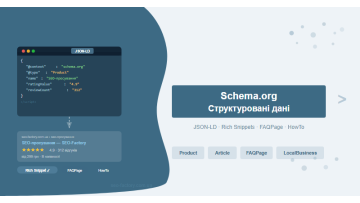
Schema.org is a structured data vocabulary jointly developed by Google, Bing, Yahoo, and Yandex in 2011. Adding JSON-LD, Microdata, or RDFa markup turns plain HTML into machine-readable data — unlocking Rich Snippets in SERP that can lift CTR by 15–30%. This guide covers types, implementation, and validation.
Contents
- What is Schema.org and why it matters
- JSON-LD vs Microdata vs RDFa
- Key Schema types for business
- FAQ Schema — implementation and impact
- HowTo Schema — when to use it
- Product and Review Schema for e-commerce
- BreadcrumbList — breadcrumbs in SERP
- How to validate your markup
- Common implementation mistakes
- Frequently asked questions
What is Schema.org and why it matters
Schema.org is a shared project launched in 2011 by Google, Bing, Yahoo, and Yandex. It is a vocabulary of over 800 entity types and thousands of properties that lets you annotate HTML content so search engines understand not just the words on a page, but their meaning and relationships.
Without markup, Google sees: "iPhone 15 Pro — $549." With Product + Offer markup it understands: "this is a product, price $549, in stock, rated 4.9 out of 5." The difference: in the second case, the SERP snippet can show the price, star rating, and availability status — right under the URL.
Why does this matter for business? According to Google's official documentation, Rich Results significantly improve click-through rates compared to standard blue links. From our experience managing e-commerce SEO campaigns, we tracked CTR increases of 20–35% after deploying Product and Review markup — especially in product categories where star ratings appear.
Structured data is also a key component of a thorough technical SEO audit — missing or broken Schema is always flagged as a separate issue block during a full site audit.
JSON-LD vs Microdata vs RDFa — which to choose
There are three formats for implementing structured data. Google supports all three but officially recommends JSON-LD as the easiest to maintain.
| Parameter | JSON-LD | Microdata | RDFa |
|---|---|---|---|
| Placement | Separate <script> block, independent of HTML | Attributes inside HTML tags | Attributes inside HTML tags |
| Google recommendation | Yes (officially preferred) | Acceptable | Acceptable |
| Implementation complexity | Low — pure JSON | High — requires HTML changes | High — complex syntax |
| Impact on HTML template | None | Significant | Significant |
| JS rendering support | Good (can be injected dynamically) | Depends on rendering | Depends on rendering |
| When to use | Everywhere — default choice | CMS blocks separate script tags | Semantic HTML5 + RDF requirements |
The conclusion is straightforward: if you can insert a <script type="application/ld+json"> block — use JSON-LD. Microdata is a workaround for hosted platforms that do not allow separate script blocks. RDFa is for projects with strict semantic web requirements.
Key Schema types for business
The Schema.org vocabulary has hundreds of types, but most commercial and informational sites need only eight core ones.
| Schema type | Who needs it | SERP benefit | Required fields |
|---|---|---|---|
| Article | Blogs, media, news | Date, author, breadcrumbs | headline, author, datePublished |
| Product | E-commerce stores | Price, availability, star rating | name, offers (price, availability) |
| FAQPage | FAQ-heavy pages | Expanded FAQ directly in snippet | mainEntity (Question + Answer) |
| HowTo | Guides, tutorials | Numbered steps shown in SERP | name, step (HowToStep) |
| LocalBusiness | Offline business, services | Address, phone, opening hours | name, address, telephone |
| BreadcrumbList | All sites with categories | Navigation path below URL in SERP | itemListElement (ListItem) |
| Review / AggregateRating | Products, services | Stars and review count | ratingValue, ratingCount |
| Organization | Corporate sites | Knowledge Panel, sitelinks | name, url, logo, contactPoint |
Tip: Don't try to implement every type at once. Start with what directly matches your content. For a blog — Article + FAQPage. For a store — Product + BreadcrumbList + AggregateRating. For a local service — LocalBusiness + Review.
FAQ Schema — implementation and impact on search results
FAQPage is one of the most effective markup types for informational pages and landing pages. When implemented correctly, Google displays questions and answers directly below the main snippet, nearly doubling the visible real estate your result occupies in SERP.
JSON-LD structure for FAQPage:
<script type="application/ld+json">
{
  "@context": "https://schema.org",
  "@type": "FAQPage",
  "mainEntity": [
    {
      "@type": "Question",
      "name": "How much does SEO cost?",
      "acceptedAnswer": {
        "@type": "Answer",
        "text": "Cost depends on niche and competition level.
Typical budgets for mid-sized sites range from $500 to $3,000/month."
      }
    }
  ]
}
</script>
Key rules for FAQPage:
- Question text (name) — must exactly match the H3 text on the page
- Answer (text) — plain text string only, no HTML tags
- Number of questions — 3 to 8; Google rarely shows more
- Answers — specific, 1–3 sentences, no "it depends on..."
- HTML Q&A block — the corresponding content must exist in the page HTML
FAQPage markup is a direct path to Google Featured Snippets and AI Overviews. See our guide on Featured Snippets: how to win position zero for the full optimization approach.
HowTo Schema — when to use it
HowTo is the markup type for step-by-step tutorials. Google can display individual steps directly in SERP (especially on mobile), letting users expand each step without visiting the site. Yes, this can reduce clicks — but your site gets a larger snippet and stronger authority signals.
When to use HowTo:
- The article is a step-by-step tutorial ("how to do X")
- There is a clear numbered list of discrete steps
- Each step describes a specific action, not a general tip
- The article is not a recipe (use the Recipe type instead)
Minimum HowTo JSON-LD structure:
{
  "@context": "https://schema.org",
  "@type": "HowTo",
  "name": "How to Set Up Google Search Console",
  "description": "Step-by-step guide to connecting GSC in under 10 minutes.",
  "step": [
    {
      "@type": "HowToStep",
      "name": "Sign in to your Google account",
      "text": "Go to search.google.com/search-console and click Start now."
    },
    {
      "@type": "HowToStep",
      "name": "Add a property",
      "text": "Enter your site URL. Using a Domain property is recommended over URL prefix."
    }
  ]
}
Optionally, add totalTime (ISO 8601 format: "PT30M" for 30 minutes) and estimatedCost for tutorials that involve spending money or buying tools.
Product and Review Schema for e-commerce
For online stores, Product and AggregateRating are the highest-value markup types. A snippet showing price, availability, and star ratings stands out sharply against competitors without structured data.
Example JSON-LD for a product page with ratings:
{
  "@context": "https://schema.org",
  "@type": "Product",
  "name": "iPhone 15 Pro 256GB Titanium",
  "image": "https://shop.com/images/iphone-15-pro.jpg",
  "description": "Apple smartphone with A17 Pro chip and 48MP camera.",
  "brand": { "@type": "Brand", "name": "Apple" },
  "offers": {
    "@type": "Offer",
    "price": "549",
    "priceCurrency": "USD",
    "availability": "https://schema.org/InStock",
    "url": "https://shop.com/iphone-15-pro"
  },
  "aggregateRating": {
    "@type": "AggregateRating",
    "ratingValue": "4.9",
    "reviewCount": "312"
  }
}
Warning: Google prohibits AggregateRating on pages without genuine user reviews. Fabricated or self-written ratings violate Google's policies and can result in removal from Rich Results entirely. Only add rating markup where real user-generated reviews exist on the page.
With e-commerce clients we have seen that accurate Product markup combined with genuine UGC reviews and solid technical foundations drove organic traffic growth of 25–40% over a single quarter — mainly through Shopping results and improved CTR on standard snippets.
BreadcrumbList — breadcrumbs in SERP
BreadcrumbList tells Google to display a navigation trail instead of the raw URL in the snippet. It appears as: Home › Phones › iPhone 15 Pro. This makes the result easier to understand at a glance and signals a well-structured site architecture to the crawler.
JSON-LD for breadcrumbs:
{
  "@context": "https://schema.org",
  "@type": "BreadcrumbList",
  "itemListElement": [
    {
      "@type": "ListItem",
      "position": 1,
      "name": "Home",
      "item": "https://shop.com/"
    },
    {
      "@type": "ListItem",
      "position": 2,
      "name": "Phones",
      "item": "https://shop.com/phones/"
    },
    {
      "@type": "ListItem",
      "position": 3,
      "name": "iPhone 15 Pro",
      "item": "https://shop.com/phones/iphone-15-pro"
    }
  ]
}
BreadcrumbList rules:
- position — sequential numbering starting at 1
- item — full URL, no shortening
- The path must match the actual site navigation
- For the last element (current page), the item field is optional
BreadcrumbList is tightly coupled with logical site architecture and technical SEO. Without a coherent URL structure, breadcrumbs will not make sense to either users or bots.
How to validate your markup
After adding Schema, always validate it. Invalid or incomplete markup can fail to generate Rich Results and may even trigger warnings in Google Search Console.
Two essential validation tools:
-
Rich Results Test (search.google.com/test/rich-results) — Google's official tool. It shows:
- Whether the markup qualifies for Rich Results
- Which fields are missing or incorrectly filled
- A preview of what the enriched result would look like
- Schema Markup Validator (validator.schema.org) — checks syntax and conformance to the Schema.org vocabulary. Catches errors that Rich Results Test sometimes misses.
Post-implementation validation checklist:
- Rich Results Test — paste URL or HTML, confirm zero errors (warnings are fine)
- Schema Markup Validator — verify JSON-LD syntax is clean
- Google Search Console → Enhancements → Rich Results — data appears 1–2 weeks after indexing
- Re-validate after every template update or major content edit
Also check how Googlebot handles JavaScript-rendered markup — covered in detail in our guide on JavaScript SEO: how Googlebot renders JS.
Common implementation mistakes
Most Schema problems repeat across sites. Here are the mistakes we find most often during technical audits.
- Markup does not match page content — JSON-LD shows price $49, but the page shows $59. Google detects the mismatch and can demote or remove the Rich Result.
- Missing required fields — for example, a Product type without an offers field. Rich Results Test will warn you; Google will not show the enriched snippet.
- HTML tags inside FAQPage answer text — the acceptedAnswer.text field must be plain text. Tags like <br> or <strong> corrupt the markup.
- Duplicate JSON-LD blocks — if the CMS template already generates an Organization or Article block and you add another manually, Google receives two conflicting signals.
- Wrong date format — datePublished and dateModified must follow ISO 8601: "2026-05-25" or "2026-05-25T10:00:00+00:00".
- Markup on hidden or inaccessible content — if content is behind a paywall or styled display:none, Google considers the markup invalid.
- Spam markup — adding FAQPage or HowTo to pages where the corresponding content blocks do not exist in HTML. This violates Google's policies and risks manual actions.
The most common mistake we encounter in practice: price mismatch in stores running sales and discounts. The CMS updates the displayed price, but the JSON-LD block stays stale. Fix: generate markup dynamically from the template rather than hardcoding it.
In Practice
A recipe website based in Lviv ran roughly 1,600 published recipes on a custom WordPress setup. The site had solid content and a loyal readership, but organic CTR had plateaued at 2.1% for over six months.
A Screaming Frog crawl revealed the root cause immediately: not a single recipe page carried structured data. Competitors ranking in positions 1–3 for high-volume queries like "chocolate cake recipe" all displayed star ratings, preparation time, and calorie counts directly in the Google snippet.
Recipe schema was rolled out across 920 pages, covering the required prepTime, cookTime, recipeYield, and nutrition fields. For 210 recipes with detailed step-by-step instructions, HowTo schema was added in parallel.
Five weeks after deployment, Google Search Console showed 34% of recipe pages qualifying for Rich Results. CTR rose from 2.1% to 5.8% — the star ratings and cook time visible in the snippet were doing the work. Ahrefs confirmed the organic footprint grew: URLs receiving at least one click per week increased from 340 to 580 over the quarter.
The biggest lesson from this project: never treat Rich Results Test warnings as harmless. Half the Recipe schema was flagged as "warnings" for missing nutrition subfields — and those pages produced zero Rich Results until the fields were filled. Errors stop Rich Results; warnings often do too, just without telling you directly.
Frequently asked questions
Is Schema.org markup required for SEO?
Schema.org is not an official Google ranking factor, but structured markup increases CTR via Rich Snippets by 15–30%, improves content understanding by crawlers, and raises the chance of appearing in AI Overviews. For competitive niches, it is effectively mandatory.
Which structured data format is best: JSON-LD, Microdata, or RDFa?
Google officially recommends JSON-LD. It stays separate from HTML, is easy to edit, and supports all Schema types. Microdata and RDFa are acceptable but harder to maintain — use them only when your CMS does not allow inserting separate script blocks.
How do I validate Schema markup on my site?
Use two free tools: Rich Results Test (search.google.com/test/rich-results) shows whether your markup qualifies for Rich Snippets; Schema Markup Validator (validator.schema.org) checks syntax and structure. Both are available without registration.
Does Schema markup affect Google rankings?
A direct correlation has not been confirmed, but an indirect one exists. Schema helps Google understand content more precisely, improving answer relevance. FAQ and HowTo markup expands snippets in SERP, boosts CTR, and a higher CTR is a behavioral signal for the algorithm.
Need help implementing Schema markup?
SEO-Factory runs full technical audits that include a complete structured data review. We identify Schema errors, deploy the right markup types, and set up GSC monitoring. The outcome: Rich Snippets, higher CTR, and better search engine comprehension of your site.