Your shopping cart is empty!
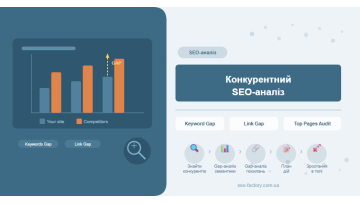
Competitive SEO analysis is the systematic process of studying sites that outrank you — uncovering their strengths, exposing gaps in your own strategy, and building a concrete plan to surpass them in organic search.
Contents
- Who your real SEO competitors are
- Tools for competitor analysis
- Analysing competitor keyword profiles
- Content gap analysis
- Reverse engineering top competitor pages
- Link gap analysis
- Building an action plan from your findings
- Common mistakes in competitor analysis
- Frequently asked questions
Who your real SEO competitors are
The single most important distinction to make upfront: your SEO competitors are not the same as your business competitors. A company selling identical services in your market may rank nowhere near your target keywords. Meanwhile, an informational blog or a marketplace aggregator might hold positions 1–3 for your highest-value terms, quietly capturing all the organic traffic you want.
That is why identifying competitors starts with the search results page, not a boardroom conversation. Three practical methods:
- Manual SERP scraping — search 5–10 core keywords in Google incognito and record every domain that appears in the top 10. Any domain showing up across three or more keywords is a priority competitor.
- Ahrefs → Competing Domains — enter your domain and the tool automatically surfaces up to 1,000 sites competing for overlapping keyword sets, ranked by a Competition Score.
- Semrush → Organic Research → Competitors — an equivalent report that also shows the percentage of shared keywords and each competitor's competitive strength score.
Practical rule: three to five competitors is enough for a focused analysis. More than that dilutes your attention. Pick sites whose traffic is similar to your target level or between 1.5–3× higher — that sets achievable benchmarks, not demoralising moonshots.
In our agency work we frequently see e-commerce clients burning analysis time comparing themselves to Amazon or dominant national retailers. A meaningful competitive benchmark is a site you can realistically overtake in six to twelve months.
Classifying competitors by type
Before diving into detailed analysis, group your competitors — each type calls for a different investigation strategy:
| Competitor type | Examples | Analysis focus |
|---|---|---|
| Direct commercial | Rival e-commerce store or agency | Full analysis: keywords + content + links |
| Informational site | Blog, Wikipedia, news media | Content depth, heading structure, featured snippets |
| Aggregator / marketplace | Amazon, Yelp, Capterra | Category architecture, filter pages, schema |
| YouTube / Reddit / forums | Video reviews, community threads | SERP features, PAA boxes, video snippets |
Tools for competitor analysis
The right tool depends on your budget and the depth of analysis you need. Here is how the leading options compare:
| Tool | Strengths | Limitations |
|---|---|---|
| Ahrefs | Largest link database, accurate organic traffic estimates | Expensive ($99–$399/month) |
| Semrush | Rich competitive features, covers paid + organic | Traffic figures can diverge from GSC data |
| Moz Pro | Clean UI, DA/PA metrics widely understood | Smaller link index than Ahrefs |
| SE Ranking | Affordable for small businesses | Less accurate in niche markets |
| Google Search Console | Free, actual Google data | Shows only your own site's data |
For a complete competitive analysis, the recommended stack is Ahrefs or Semrush for keywords and links, plus GSC for your own baseline data. Free tools work well for initial discovery, but they fall short for deep gap analysis.
Budget tip: if you can only afford one paid tool, Semrush tends to offer more competitive intelligence features at the entry tier — particularly Keyword Gap and the trial access. Ahrefs is more precise for link profile work.
Analysing competitor keyword profiles
Keyword profile analysis means exporting every keyword a competitor ranks for and identifying patterns: which query types drive their traffic, where their easiest wins sit, and what clusters you are missing entirely.
Step-by-step in Ahrefs
- Open Site Explorer → Organic Keywords for a competitor's domain.
- Filter positions 1–10 — only keywords where they actually appear in the top results.
- Sort by Traffic to surface the terms driving the most visits.
- Add a second filter: KD ≤ 30 — these are "soft" keywords accessible without a massive link budget.
- Export 50–200 keywords, then group them into topic clusters.
In our practice this process takes one to two hours per competitor. The output is a spreadsheet of keywords with position, traffic estimate, and the URL of the ranking page — the raw material for everything that follows.
What to look for in a competitor's keyword profile
Scan for these patterns rather than reading the list linearly:
- Top-5 clusters with low KD — traffic that is there for the taking.
- Commercial intent keywords ("buy", "price", "best", "review") — signals of monetisable demand.
- Long-tail queries (3–5 words) — often less competitive and highly qualified visitors.
- Local modifiers ("+ city", "near me") — critical for local businesses.
- Brand keywords — filter these out; they are not replicable.
Analysing the keyword profiles of just 10 competitors typically surfaces between 300 and 1,500 new keyword ideas for your content plan. That is far faster than keyword brainstorming from scratch.
Content gap analysis
A content gap analysis identifies keywords your competitors rank for that you currently do not. It is the fastest way to spot blind spots in your content strategy — and the quickest path to incremental traffic gains.
Running Content Gap in Ahrefs
- Go to Site Explorer and enter your own domain.
- In the left menu, click Content Gap.
- In the "Show keywords that the below targets rank for" fields, add 2–5 competitor domains.
- In the "But the following target doesn't rank for" field, enter your domain.
- Click Show keywords.
The results list keywords sorted by traffic potential and show how many of your competitors rank for each one. If all five competitors rank for a keyword and you do not, that is a critical gap to address first.
Running Keyword Gap in Semrush
- Open Keyword Gap from the left sidebar.
- Enter your domain and up to four competitor domains.
- Select analysis type: Organic.
- Apply the Missing filter — keywords competitors rank for that you do not.
- Then check Weak — keywords where you rank but below your competitors.
Prioritisation rule: focus first on keywords with Volume > 100 and KD < 40. This is your "accessible traffic" window — specific enough to convert, competitive enough to win without an enterprise budget.
Four categories of content gaps
Structuring your gaps by type makes them easier to act on:
- Missing page — a competitor has a dedicated page for the keyword, you have none. Fix: create the page.
- Thin content — you have a page but it ranks at position 15–30. Fix: rewrite or significantly expand.
- Wrong format — the query demands a list or tool, but you have a wall of prose. Fix: reformat to match SERP intent.
- Missing topic cluster — a competitor covers an entire theme across 10–20 pages; you have one. Fix: build a content cluster plan.
Reverse engineering top competitor pages
Analysing individual competitor pages is the deepest level of SEO intelligence. The goal is to understand why a specific page ranks number one — and to determine exactly what you need to do to surpass it.
Step 1: identify the pages worth studying
In Ahrefs Site Explorer → Top Pages, or Semrush → Organic Research → Pages. Sort by traffic and select 10–20 pages that overlap with your target topics.
Step 2: audit structure and format
For each page, manually check these elements:
- Word count — how long does Google consider "thorough" for this topic? If every top-5 result has 2,000+ words and yours has 800, the gap is glaring.
- Heading structure — which sub-questions does the article answer across H2s and H3s? This is a map of semantic coverage.
- Content format — lists, tables, embedded video, calculators, downloadable assets. Structured content tends to perform better in rich results.
- Internal links — which pages does the competitor link to from this article, and which pages link back to it? This reveals their site architecture logic.
- Last updated date — freshness matters for news-adjacent or rapidly evolving topics.
Step 3: check SERP features
Identify which SERP features the competitor's page holds — featured snippet, People Also Ask positions, video carousel, image pack. Each feature has its own optimisation format. For a deep dive on capturing position zero, see our guide to featured snippets.
Page analysis checklist:
✓ Word count recorded
✓ All H2 / H3 headings documented
✓ Content format (list / article / guide / tool) identified
✓ Internal link count noted
✓ External sources referenced
✓ Schema markup tested via Google Rich Results Test
✓ Page Speed checked via PageSpeed Insights
✓ Word count recorded
✓ All H2 / H3 headings documented
✓ Content format (list / article / guide / tool) identified
✓ Internal link count noted
✓ External sources referenced
✓ Schema markup tested via Google Rich Results Test
✓ Page Speed checked via PageSpeed Insights
The 10x content principle
Copying a competitor's structure is not enough — Google is increasingly effective at detecting thin imitation. The 10x content principle (coined by Rand Fishkin) says your page should be ten times more useful than the best result currently in the SERP. In practice this means:
- specific data and examples rather than generalities;
- original research or first-hand case studies;
- superior visual presentation (diagrams, annotated screenshots);
- practical templates or checklists users can apply immediately;
- a regular update cycle so data never grows stale.
Link gap analysis
A link profile is one of the hardest assets to replicate quickly. If a competitor has 500 high-quality backlinks and you have 50, content improvements alone will not close that gap. Link gap analysis surfaces referring domains that already link to your competitors — sites pre-qualified as relevant and willing to link — that have not yet linked to you.
Link Intersect in Ahrefs
- Open Link Intersect (found under More tools).
- In the "Show results that link to" fields, enter 3–5 competitor domains.
- In the "But not link to" field, enter your domain.
- Filter results by DR ≥ 40 and exclude obvious link farms and PBN networks.
Backlink Gap in Semrush
- Open Backlink Gap.
- Enter your domain alongside your competitor domains.
- The tool shows shared and unique referring domains for every site in the comparison.
- Apply the Best filter — the strongest referring domains linking to competitors but not to you.
For a detailed guide to building and maintaining your link profile, see our article on link building strategy.
How to qualify donors for outreach
Not every competitor donor is worth pursuing. Here are the qualification criteria:
| Criterion | Minimum | Ideal |
|---|---|---|
| Domain Rating (DR) in Ahrefs | ≥ 30 | ≥ 60 |
| Organic traffic of donor site | > 500/month | > 5,000/month |
| Topical relevance | Related niche | Same niche |
| Link type | Dofollow | Dofollow from contextual body text |
| Outbound links from that page | < 50 | < 10 |
A word of caution: avoid mass link buying. Google's Penguin algorithm is highly effective at detecting unnatural link velocity spikes. Five strong editorial backlinks per month outperform 100 from low-quality directories — every time.
Building an action plan from your findings
Analysis without a plan is just a report. The output of competitive research should be a prioritised task list — concrete, time-bound, and tied to measurable outcomes.
The 2×2 priority matrix
For every opportunity discovered, score it on two axes: traffic potential and effort required. The matrix tells you what to do when:
- High traffic + low effort — tackle immediately. These are your quick wins.
- High traffic + high effort — plan for a 2–3 month horizon.
- Low traffic + low effort — batch and handle as background work.
- Low traffic + high effort — deprioritise or remove from the list entirely.
The four components of your post-analysis plan
- Content plan: new pages and articles to cover gap keywords — each with target keyword, proposed URL, intended format, and a publish deadline.
- Content refresh list: existing pages ranking at positions 11–30 that need expansion, rewriting, or reformatting.
- Outreach pipeline: a list of donor sites with contact details — categorised by outreach type (guest post, citation, partnership, broken-link replacement).
- Technical backlog: if analysis reveals technical weaknesses (site speed, mobile experience, Core Web Vitals), these go into a separate developer-facing backlog.
We have tested various cadences across client projects and the data is consistent: companies that revisit competitor analysis every quarter and update their action plan grow organic traffic 35–60% faster than those treating it as a one-time exercise.
To run a full technical review alongside your competitive research, see our technical SEO audit guide.
Common mistakes in competitor analysis
Even experienced SEOs fall into these traps — knowing them in advance saves weeks of misdirected effort:
- Analysing business competitors instead of search competitors. You end up studying sites that do not actually compete with you in Google, and miss the real threats.
- Copying structure without understanding causation. A competitor publishes 3,000-word articles — you do the same — but the ranking reason was actually their link profile, not word count.
- Ignoring SERP intent. Before writing any content, check what format Google shows in the top 10 for your target query. A list post and a long-form guide signal very different intents.
- Treating it as a one-time project. The SEO landscape shifts continuously. A strategy derived from data that is twelve months old may be completely misaligned with today's SERP.
- Over-indexing on links. Links matter enormously, but 70–80% of what causes a page to rank is serving the right intent with quality content. Links amplify good content; they rarely compensate for weak content.
- Overlooking competitor internal linking structures. How they pass PageRank between pages often explains ranking anomalies. Our guide on internal linking and site architecture covers this in depth.
The key framing: competitive analysis is a map, not a route. It shows where paths exist, but you still have to decide which path to take based on your resources, timeline, and business priorities.
For a detailed methodology reference, the Semrush team publishes an excellent guide: Competitive SEO Analysis on the Semrush blog — worth bookmarking alongside your own process documentation.
To deepen your understanding of how competitors build their semantic strategies, read our guide on building a keyword semantic core and clustering.
Frequently asked questions
How do I find my SEO competitors rather than my business competitors?
Search 5–10 target keywords in Google incognito and note which domains appear most often in the top 10. Use Ahrefs Competing Domains or Semrush Organic Research → Competitors — these tools automatically surface sites competing for the same keywords, even if they are not your business rivals.
What is a content gap analysis and why does it matter?
A content gap is a set of keywords your competitors rank for but you do not. The Content Gap tool in Ahrefs or Keyword Gap in Semrush compares your keyword profile against 2–5 competitors and surfaces blind spots in your content strategy. Filling these gaps drives quick traffic gains without requiring new links.
How often should I run a competitive SEO analysis?
Run a full competitor audit once per quarter. After any major Google algorithm update or a sudden traffic drop, run an unscheduled review. Monitor new pages from top competitors in Ahrefs New Pages weekly or monthly.
Can I do competitive analysis for free?
Partially. Google Search Console shows your own keywords and positions, and the free tiers of Ubersuggest or Semrush let you inspect individual URLs. However, a full link and keyword gap analysis requires a paid Ahrefs or Semrush subscription — without it the picture will be incomplete.
Need a competitive SEO analysis?
The SEO-Factory team delivers full competitor audits covering keyword profiles, content gaps, link profiles, and technical advantages — packaged as a prioritised action plan with clear next steps for organic growth.
Get a website promotion proposal